Login
Get an introductory Jacobin subscription for just $20
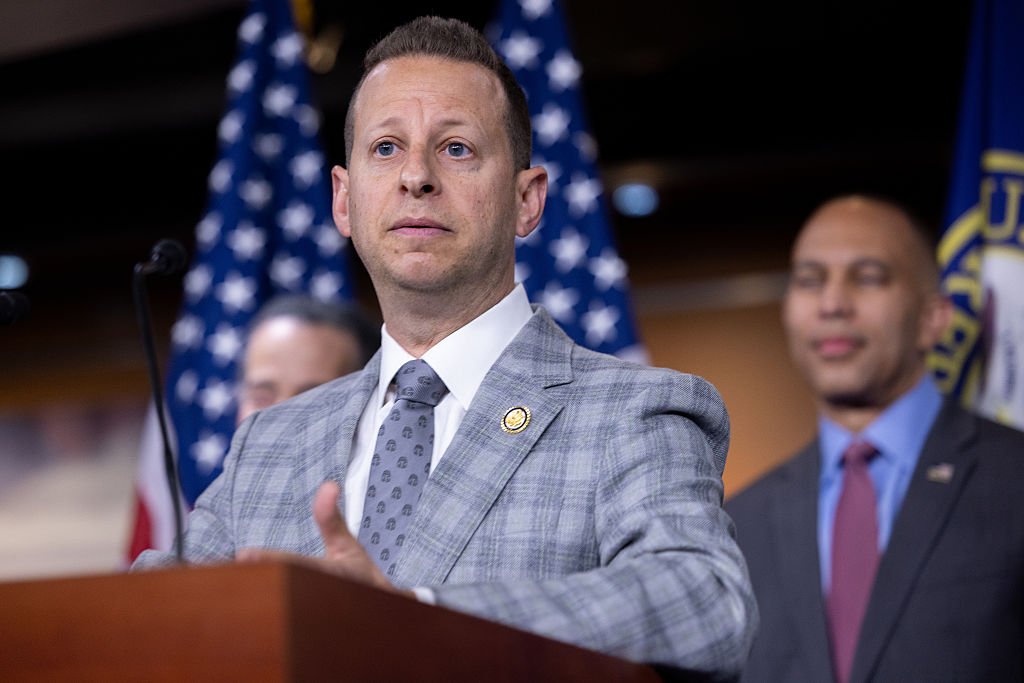
Putting Jared Moskowitz in charge of Middle East policy isn’t just a slap in the face to Democratic voters — it’s an empowerment of a leading Democratic supporter of Trump’s disastrous Iran war and free speech crackdown.
Hakeem Jeffries is in a pickle. He understands that both the Iran war and unconditional US support for Israel are lethally unpopular with voters. But he can’t stop supporting Israel, no matter how indefensible its actions. (Nathan Posner / Anadolu via Getty Images)
Get four print issues and full access to our archive for just $20
The “civil war” currently playing out in the Democratic Party is usually thought of as a battle between socialists and progressives on the one hand, and centrists on the other. Which it is. But it’s also a battle between the Democratic establishment and its own voters.
If you need proof, look at party leadership’s plans to install Jared Moskowitz and several other right-wing Democrats in influential foreign policy positions if the party retakes the House of Representatives.
“I’ll be in a position to help steer US policy on Israel and the Middle East,” said Moskowitz, who will become chair of the Middle East and North Africa subcommittee if the party wins big in November.
The views of the Democratic electorate on Israel are not ambiguous. A recent poll carried out by YouGov, for example, found that majorities of upward of 60 percent of Democratic voters across several key states overwhelmingly want their 2028 presidential candidate to cut off weapons for Israel and even sanction Israel over its illegal behavior.
Moskowitz’s appointment is, to put it lightly, a slap in the face of this supermajority of his party’s own voters. Moskowitz is a darling of the American Israel Public Affairs Committee (AIPAC) for his implacable support for Israel’s genocide, opposing a ceasefire for months while Israeli forces carried out some of the worst killing and vehemently opposing any conditions whatsoever on US aid to Israel — even though, under US law, it’s already illegal to send aid to states violating human rights.
At one point, he was one of just sixteen Democrats to join the GOP in voting to reverse former President Joe Biden’s decision to stop sending Israel the largest, most indiscriminately destructive US bombs. At various points, he led a congressional effort to conceal the number of civilians Israel had killed, voted to defund the United Nations (UN) agency responsible for helping Palestinian refugees, and authored a bill to defund the UN if it expelled Israel, which he has introduced multiple times.
In fact, it’s fair to say that, if it were up to Moskowitz, he would probably outlaw the views of most of his own party’s voters. He authored a resolution absurdly declaring “From the river to sea” an antisemitic call for violence, and voted to censure his own Democratic colleague, Rashida Tlaib, because she suggested Israel bombed a hospital in Gaza — a hospital that Israel has proceeded to repeatedly bomb in the years since, besides bombing every other hospital in the territory.
Since then, he has lent his full support to Donald Trump’s free speech crackdown, supporting Trump’s attempt to deport a green card holder critical of Israel, writing a bill to punish Americans who boycott Israel, and pressuring Trump to retaliate against Colombia because of its president’s criticism of the country, which he did. Before Trump took office, Moskowitz had agitated for a federal crackdown on campus protests that he absurdly likened to white supremacist rallies, another policy that has become a defining feature of Trump’s authoritarian second term.
But beyond Israel and Palestine, House Minority Leader Rep. Hakeem Jeffries’s decision to elevate Moskowitz also hands the party’s Middle East policy to a supporter of what has proven to be Trump’s most disastrous foreign policy decision, both on the politics and its actual outcomes for US interests: the Iran war.
In the lead-up to Trump and Benjamin Netanyahu’s first attack on the country last year, Moskowitz described himself as “to the right of this issue to the J. D. Vance-[Steve] Witkoff approach, and I agree, quite frankly, more with Senator Lindsey Graham and probably Senator Tom Cotton.” The fact that he quickly slipped in the claim that he wasn’t calling for bombing was undermined by the fact that bombing Iran was the long-standing position of both Graham and Cotton. Sure enough, Moskowitz put out a press release supporting the Israeli bombing a month later and went on Fox News to defend it.
Moskowitz went one further with Trump’s all-out war on Iran this year, which has turned into a six-month-long quagmire that’s caused huge numbers of casualties and made the cost of living spike for US consumers.
This time, rather than mere rhetorical support, Moskowitz gave Trump material aid to start the war. He publicly refused to vote for a War Powers Resolution being brought by the bipartisan duo of Ro Khanna and Thomas Massie to prevent Trump from acting on the horrible advice of the dumbest right-wing war hawks, labeling the effort to constrain him “the Ayatollah Protection Act.” It put him on the other side of most of his own party and its top leadership who backed the measure, including Jeffries himself.
Having helped Trump get the country into this mess, Moskowitz then predictably took the position that the United States had no choice but to stay in the war as long as possible and get sucked even deeper into it.
“Now that we’re there and we’re in this war, we have to get the uranium. We can’t just go home,” he said in June, pointing to the US deaths and other costs that his support for the war made happen.
Any deal to end the war — which he totally supports, Moskowitz assured viewers — had to involve Iran dismantling its nuclear sites and handing over its uranium, maximalist demands that would functionally make it impossible for the United States to extricate itself from the war.
The fact that Moskowitz and Jeffries were on different sides of the most consequential US foreign policy question of the year (and probably the decade), yet Jeffries has picked him to potentially steer US foreign policy in the region anyway, suggests two things.
One is that Jeffries’s support for the War Powers Resolution to prevent Trump’s war was as half-hearted as many critics suspected. Recall that there was already reporting earlier this year that Democratic leaders actually wanted Trump to start a war with Iran, a war they ardently desired but didn’t want to face the political blowback for carrying out themselves.
The other is that it points to the role Moskowitz will play for the party’s corporate faction moving forward. Centrists like Jeffries understand that both the Iran war and unconditional US support for Israel are lethally unpopular with voters but are committed to both, partly for ideological reasons and partly because of their alliance with large, pro-Israel donors. By plonking Moskowitz and other Israel First ideologues into these positions, they can let them take the heat for the hawkish foreign policy decisions they secretly favor while publicly posturing that they’re in line with what Democratic voters want.
Moskowitz and the rest will play political cover for a leadership that remains out of step with, if not actively hostile to, the will of its own voters. It’s a strategy that will translate into more disastrous foreign policy choices that the rest of the country has to live with — but also only remains viable as long as Moskowitz and the others are able to keep winning their races.
Branko Marcetic is a Jacobin staff writer and the author of Yesterday’s Man: The Case Against Joe Biden.
{{ message }}
Thanks for signing up! →
Already on our list? Get our print magazine for just $20 a year.
Get four print issues and full access to our archive for just $20
A journal of theory and strategy published by Jacobin
{{ message }}