Bernie Sanders isn’t in the Democratic Party. But he’s refashioning it in his image. – MS NOW

Live TV
Rachel Maddow
Morning Joe
Deadline: White House
Our Shows
Opinion
Live Q&As
Community
Explore
Share this:
TRENDING NOW
Mondays at 9PM ET
Weekdays at 6AM ET
Weekdays at 4PM ET
Weeknights at 10PM ET
Tuesdays – Fridays at 9PM ET
Weeknights at 7PM ET
Weeknights at 11PM ET
Weekdays at 11AM ET
Weeknights at 8PM ET
Weekdays at 9AM ET
Weeknights at 6PM ET
Weekends at 10AM ET
Weekends at 1PM ET
Weekends at 5PM ET
Weekdays at 2PM ET
Weekdays at 12PM ET
Weekends at 7AM ET
Weekdays at 5AM ET
Search
MS NOW TV
Watch Live
Rachel Maddow Show
Morning Joe
Deadline: White House with Nicolle Wallace
The Last Word with Lawrence O’Donnell
The Briefing with Jen Psaki
The Weeknight
11th Hour with Ali Velshi
State of Play with Peter Alexander
All In with Chris Hayes
Money, Power, Politics with Stephanie Ruhle
The Beat with Ari Melber
Connect with Jacob Soboroff
The Assignment with Antonia Hylton
PoliticsNation with Al Sharpton
The Moment with Katy Tur
The Weekend
Way Too Early with Ali Vitali
Listen Live
TV Schedule
For Members
Live Q&As
Member-Exclusive Series
Community
More from MS NOW
Opinion
Newsletters
Elections
White House
Congress
Supreme Court
Culture
World
Science & Tech
Civil Rights
Business
Sports
Events
Podcasts
The self-described democratic socialist has managed to reshape the Democratic Party with candidates he has inspired, mentored, funded or recruited.
Before the upcoming midterm elections, Sen. Bernie Sanders, I- Vt., has pulled off what he couldn’t in his two presidential campaigns. The self-described democratic socialist has managed to reshape the Democratic Party, and potentially its trajectory, with a new generation of upstart candidates he has inspired, mentored, funded or recruited.
Unlike in past years, when Sanders was relatively late in making endorsements to ensure he was backing viable candidates, he jumped in early this cycle — and he jumped in big, with more than 70 endorsements for positions in Washington and across the country, including House and Senate seats and state insurance commissioner races. Seventy-five percent of his endorsed candidates won their primaries, according to Sanders’ team.
Some who won the Sanders tap of approval are relative newcomers and are not the kind of candidates typically championed by a Democratic party establishment constantly worried about alienating centrist or right-leaning voters. The Wall Street Journal and Axios have suggested that Sanders has become a “kingmaker.” The midterms will help determine how true that is.
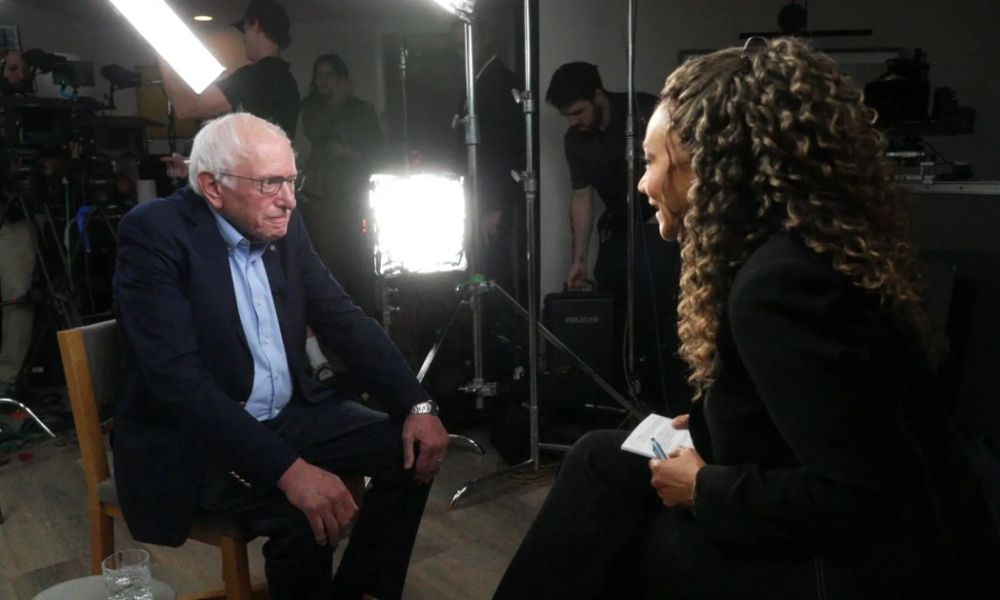
I conducted an extended interview with the senator for a special airing this weekend on MS NOW, called “Long Game: The Bernie Sanders Effect.” The two-hour special, which airs Saturday at 8 p.m., examines the improbable arc of Sanders’ life and political career, including his childhood in Brooklyn, where money was tight and his parents died young; his challenge to the longtime political machine in Burlington, Vermont, as an upstart socialist candidate for mayor; his two presidential campaigns, during which he drew some of the largest, loudest and most loyal crowds; and his effort to create a far-reaching progressive movement after he failed to win the nomination.
Our team also interviewed New York Mayor Zohran Mamdani and Rep. Alexandria Ocasio-Cortez of New York, both of whom were closely mentored by Sanders and share his belief that the Democratic Party has not always served the interests of working-class and poor Americans.
“The Democratic Party failed working-class people on economic issues,” Sanders told me in our sit-down. “I think they have a lot to be proud of in terms of fighting for civil rights, for women’s rights, for gay rights, for environmental stuff. But in terms of working-class issues, no. I don’t think they’ve done a good job. So a lot of workers out there say, ‘Well, you know, we voted for you. Our fathers voted for you. To hell with you.’”
Sanders is committed to trying to seize control of the House and the Senate for Democrats to provide a check on President Donald Trump’s power. But with a string of upstart candidates, who in some cases call themselves party “insurgents,” he and they are simultaneously challenging the Democratic Party itself and its cadre of consultants, corporate donors and traditionalist party gatekeepers.
“What we need to understand and figure out is how we bring together the insurgent working-class youth movement that is taking over the polls,” Ocasio-Cortez told me. “The energy and the momentum is with an ascendant generational shift.”
That so-called insurgency within the party that pushes a progressive agenda, rejects corporate funding, criticizes Israel and is determined to pull Democrats to the left has created some real heartburn inside the party.
El-Sayed and AOC are already thinking beyond 2026 bt test driving a national platform for the left. www.semafor.com/article/10/1…
“If those candidates succeed, then he is a kingmaker and his support will be sought after in 2028 and beyond,” said our MS NOW colleague Steve Benen, a political historian and writer who has followed Sanders’ career as a longtime Vermonter. “If those candidates fall short, it’s a very different story. Bernie Sanders starts to be seen as a villain among Democratic leaders.”
To some degree that has already started. Rahm Emanuel, the former Obama White House chief of staff, mayor of Chicago and likely 2028 presidential contender, wrote a scathing column in The Wall Street Journal in July with the headline, “The ‘Bernie Bros’ Could Spoil Democrats’ Midterms.” Emanuel argued that Republicans would make every Democrat in the country answer for the most radical positions of the Democratic Socialists of America, such as abolishing prisons and defunding the police and the Department of Defense — even though many of candidates Sanders has endorsed are neither socialists nor DSA members.
For example, Abdul El-Sayed, the Democrat running for the Senate from Michigan, rejects the socialist label and instead calls himself a “progressive capitalist,” and has gladly accepted Sanders’ endorsement as well as a $1 million donation from proud DSA member, Ocasio-Cortez. Angie Nixon, who’s running for the Senate from Florida, joined the DSA in June and has accepted its fundraising and organizational support but has said she is not a socialist. Other Sanders-backed contenders — Senate candidates Peggy Flanagan in Minnesota, Troy Jackson in Maine and Rebecca Cooke in Wisconsin — are not socialists and never have been.
Abdul El-Sayed, the Democrat running for the Senate from Michigan, rejects the socialist label and instead calls himself a “progressive capitalist,” and has gladly accepted Sanders’ endorsement as well as a $1 million donation from proud DSA member, Ocasio-Cortez.
Nonetheless, Republicans have used the socialist label and the more extreme aspect of the DSA platform to suggest Democrats are too radical for mainstream America. But as Benen explained, the socialist label doesn’t carry the taint or the baggage it once did, especially among young voters.
“For the longest time, you hear the word socialism, and you think Fidel Castro, you think of Soviet Union. You think these horror shows, and people were, I think were reflexively opposed to the very idea,” Benen said. “I think that now there are polls that show socialism itself is no longer this nightmare word that people are so afraid of. And, in fact, it’s growing. We were seeing it have increasing popularity, especially among younger voters.” He said Republicans using “socialism” as “this evil word to scare voters away isn’t working because socialism as a concept is becoming more popular.”
That insight applies to some places more than it does in others. Several of the Bernie- backed candidates embrace his money, his campaign infrastructure and the huge crowds he can bring to rallies more than Sanders’ democratic socialist label or ideology.
Whatever they call themselves, all of the candidates Sanders has endorsed tout the basic tenets of his progressive agenda: addressing economic inequality, providing healthcare for all, fighting corporate greed and rejecting a political system that rewards the rich while shortchanging the working class. Sanders argues that those messages resonate with voters everywhere, not just in blue-leaning districts, and he and Ocasio-Cortez, his frequent road companion, are testing that theory by taking their Fighting Oligarchy Tour and their prodigious campaign war chest to GOP strongholds to court the very voters establishment Democrats worry about alienating.
I think we are putting a major thesis to the test. But it’s about time that we do that because we have tried this old playbook over and over and over again.
“I can’t tell you how many times I’ve heard things like, or heard things insinuated, like a Muslim man can’t win in Michigan. Or that a candidate like Angie Nixon can’t win in Florida,” Ocasio-Cortez said.
When I asked her if that strategy would work in a general election, she said, “I think we are putting a major thesis to the test. But it’s about time that we do that because we have tried this old playbook over and over and over again.”
For his part, Sanders has created a new playbook in which endorsements come with an infrastructure that includes money, a system for identifying and motivating voters, an expansive and effective get-out-the-vote network, and the “Fighting Oligarchy” road show that began in early 2025. The tour draws massive crowds in a festival-like atmosphere that can generate enthusiasm and encourage voter registration.
It should be said that Sanders can complicate things for Democrats in swing states or districts. James Talarico, who is running for U.S. Senate against Republican Ken Paxton, said he will skip the Fighting Oligarchy’s three-city swing through Texas next week as that race tightens.
With a string of primary wins, the test now is whether Sanders-backed candidates on the far-left, progressive flank, who won with enthusiastic support from like-minded voters, can appeal to less ideological Democrats, centrist independents and even GOP voters who have grown weary of Trump.
Sanders has always insisted the movement is not about him. But given the amount of time and energy he has invested and all the candidates he has endorsed, in many states on Nov. 3, it will be.
Michele Norris will be answering Members’ questions about her interview with Bernie Sanders during an exclusive Q&A on Saturday at 6 p.m. ET.
Become a Member today and join live.
Michele Norris
Michele Norris is a senior contributing editor for MS NOW.
Get full access to exclusive coverage and member-only content
One of the co-hosts of MS NOW's The Weekend, Jackie Alemany, Jonathan Capehart, or Eugene Daniels will take Members' questions on the week's biggest developments.
Get full access to exclusive coverage and member-only content
One of the co-hosts of MS NOW's The Weekend, Jackie Alemany, Jonathan Capehart, or Eugene Daniels will take Members' questions on the week's biggest developments.
Paul Farhi
Anthony L. Fisher
The Associated Press
Lisa Rubin
Ja’han Jones
Steve Benen
Jordan Rubin
Jordan Rubin
Jordan Rubin
Meet the Team
Everything MS NOW, all together. Discover the shows everyone's talking about.
Explore
Explore
Explore
Explore
Explore
Explore
Explore
Explore
Explore
Explore
Explore
Explore
Get the MS NOW App
© Versant Media, LLC

Opinion: Whoever wins this election, we lose – Concord Monitor