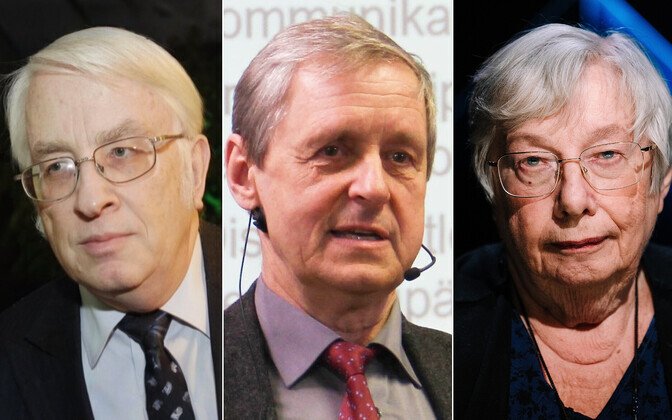

Estonia needs a new mechanism for making long-term strategic decisions that brings together experts, politicians and citizens while remaining above day-to-day party politics, Erik Terk, Mati Heidmets and Marju Lauristin write.
The world finds itself in rough seas where many of the old rules and assumptions no longer apply. The power struggle between major powers and the redistribution of positions in the global market are dangerously rocking the boats of small countries, but they may also open up new windows of opportunity.
We must place Estonia within the broader picture of a changing world to ensure both our resilience against threats and our capacity for development. We need both the ability to adapt quickly and the capacity to make strategic changes that require sustained action over a longer period.
Unfortunately, we are witnessing trends in the opposite direction.
For example, efforts to reform the energy, education and healthcare systems are becoming bogged down in a deadlock of conflicting initiatives. Strengthening defense capabilities, ensuring the sustainability of the Estonian language and culture and achieving economic success all require a long-term vision, consistent action and shared determination.
Without these, development becomes erratic. Today we rush in one direction, tomorrow in another. Eventually, we may even lose sight of what kind of society we want to be once we have somehow managed to struggle through the waves of crises.
Successful governance of Estonia requires a different mechanism for shaping the future than the current practice of short-term political agreements can provide.
While firmly defending the values of democratic governance, we must acknowledge that the traditional forms of representative democracy inherited from the last century have become trapped in partisan conflicts that prevent them from effectively managing today’s rapid and complex changes.
Building resilience for the future requires a broader societal platform that would both strengthen the intellectual capacity for planning long-term development and help ensure the quality and consistent implementation of strategic decisions that shape the country’s future, regardless of the turbulence of day-to-day political confrontations.
To achieve this, we must find a way to bring together all the knowledge and goodwill available in Estonia when preparing decisions that will shape long-term development. This means involving as many leading researchers from different fields as possible, experts with significant international experience, political leaders from different party backgrounds, experienced and critically minded entrepreneurs and specialists who stay out of party politics and active ordinary citizens with extensive practical experience.
Borrowing the name of the Convention on the Future of Europe, which met some years ago, we have called our proposed mechanism the Estonian Convention on the Future. It would be a body that convenes periodically to review and refine the country’s course of development and examine possible solutions to emerging issues of central importance.
The convention would not relieve elected representatives of their responsibility for political choices. Rather, it would serve as an additional or supporting mechanism for parliament, providing a stronger scientific and societal foundation for policymaking. As a body that we could reasonably expect to act in Estonia’s overall interests, it would operate at some distance from day-to-day political life and competition between parties.
The convention would not make final decisions. Its task would be to carry out essential preparatory work for strategic choices, bringing together knowledge, experience and different perspectives from across society, examining alternatives and formulating possible options and proposals. Ideally, the convention could develop a comprehensive vision of development that takes into account the key dimensions of Estonia’s future: social well-being, economic competitiveness, national security, environmental protection, demographic sustainability and the vitality of Estonian-language cultural life.
The central principle behind the convention’s structure would be to bring together two distinct levels of participation: experts and the public.
On one side would be what we might call a chamber of experts, to which Estonia’s knowledge-based umbrella organizations, such as universities, the Estonian Academy of Sciences and professional associations, would delegate representatives. All political parties represented in parliament would also be able to appoint representatives. The chamber of experts would operate through a series of sessions held over a designated period.
On the other side, the convention would include a chamber operating as a citizens’ assembly, giving citizens interested in solving problems the opportunity to contribute their ideas and proposals to the formulation of strategic decisions through an online discussion platform.
The online citizens’ assembly could be formed through both voluntary registration by individuals wishing to participate, with the necessary personal information provided and the application of representative sampling principles.
Both chambers of the convention would need to be supported by a team of specialists responsible for organizing expert sessions, managing the online citizens’ assembly platform and ensuring the flow of information between the two levels.
Artificial intelligence could be used to quickly summarize and compare expert opinions and citizens’ proposals, formulate recommendations based on them and put those recommendations to a vote. It could also be used to analyze background materials and datasets relating to the issues under discussion and visualize possible solutions.
In this way, the convention could become a genuine forum for collective deliberation, helping to build societal consensus on strategic issues important to Estonia’s future. It would also enable both lawmakers and the government to base their plans for reforms with long-term consequences on a diverse range of thoroughly examined, publicly debated and interconnected perspectives.
—
Follow ERR News on Facebook and X and never miss an update!
Editor: Marcus Turovski
ERR News is the English-language service of Estonian Public Broadcasting, run by a fully independent editorial team.
To read up on ERR News’ comments rules and to contact ERR’s other services, please follow the link below.