
If the fire alarm in your dorm went off every night, you would eventually stop evacuating the building.
President Donald Trump is pulling that fire alarm now, in the name of national security. During his second term, Trump has invoked national security to justify building a $400 million White House ballroom with an alleged underground bunker. He also imposed sweeping “Liberation Day” tariffs on nearly every U.S. trading partner by declaring the trade deficit a national emergency.
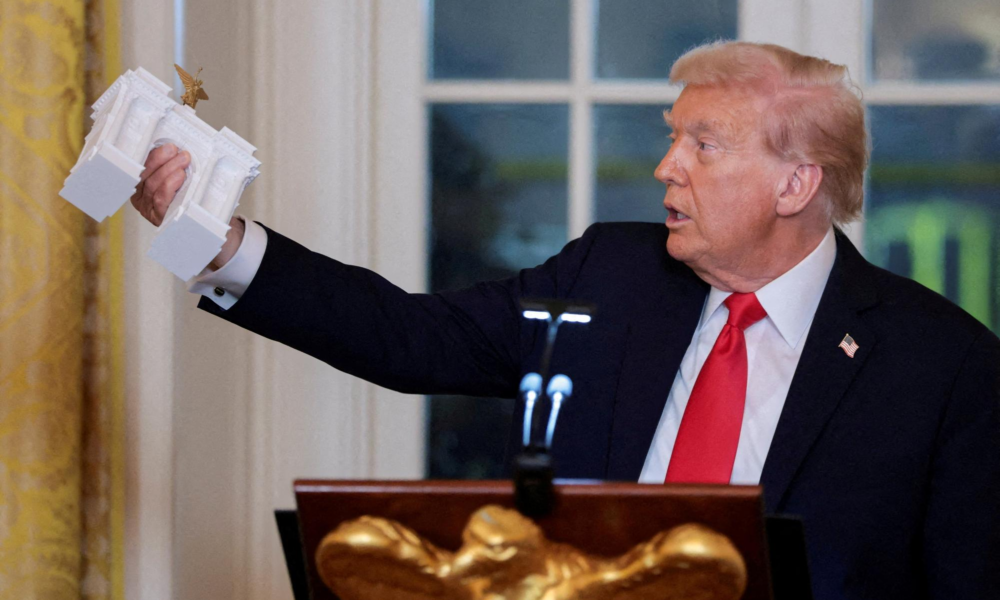
Trump announced Sep. 20 that his planned 250-foot triumphal arch near Washington, D.C. would double as a military complex complete with rooftop snipers, drones and large quantities of ammunition.
In the name of national security, a president can command the military, impose sanctions and restrict who enters the country. Although Article II of the Constitution makes the president “Commander in Chief” of the military, Article I enables Congress to declare war, organize military forces, set tariffs and order the National Guard to “repel invasions.”
This means that each time Trump labeled an initiative as part of “national security,” he gave himself permission to act without congressional approval.
The specific emergency powers Trump has invoked come from statutes, such as theNational Emergencies Act of 1976 that lets a president declare an emergency. The president is entitled to more than 100 powers written into other laws, including the International Emergency Economic Powers Act (IEEPA) Trump used to justify his policies surrounding tariffs.
However, the law does not specifically define what constitutes an emergency. Although Congress can end an emergency by passing a bill against it, the bill can be vetoed by the president unless two-thirds of Congress overrides the veto. In 2019, Trump vetoed Congress’ attempt to prevent the establishment of an emergency fund that would be used to build the US-Mexico border wall.
In Youngstown v. Sawyer (1952), Supreme Court Justice Robert Jackson described a scale of presidential power: a president acting with Congress’ authorization stands on the strongest ground, and one acting against its will stands on the weakest.
“When the President takes measures incompatible with the expressed or implied will of Congress, his power is at its lowest ebb,” Jackson wrote.
The emergency statutes presidents can declare blur that scale. They let a president claim Congress’ authorization for an action even when Congress objects. With a national security label added, a dispute that belongs at the lowest ebb gets treated as if it sits at the maximum side of the scale.
Neither the White House ballroom nor the arch began as national security projects. In fact, Trump started calling each a “military complex” and urgent security priorities only after lawsuits slowed down their construction. The final plans for the arch do not include the military features Trump touted.
The same is true of Trump’s tariffs. IEEPA was established to defend against “unusual and extraordinary” threats, yet was used by Trump when he called the trade deficit an emergency, despite the same deficit existing for decades.
Trump is using the term “national security” as an excuse to sidestep Congress and take advantage of the Court.
— Thomas Xiang
However, defenders of the tariff may point to history. For example, former president Richard Nixon invoked trade imbalances as a national emergency to impose tariffs, which was upheld by the federal court. Vice President JD Vance also argued that when Congress gave the president power to “regulate imports,” they should mean what they said.
If the arch and ballroom construction are responses to genuine security threats, these projects would have been shaped by those threats from the start. A senior White House official, speaking anonymously to Reuters, called turning national security into an all-purpose defense “not ideal,” but said it changes “the legal and political terrain of a dispute.” In other words, once a policy carries the national security label, any fight over it in court or in Congress gets harder for opponents to it to win.
Nowadays, national security seems more like a litigation strategy. A national security policy is designed to stop a threat; a litigation strategy is designed to win a case. The same official said the White House uses the term national security because of the effect it has on judges instead of its intended use to describe something that will protect the U.S. against threats.
If ‘national security’ is being used because it makes courts tend to back off, it is clear that Trump is abusing the term to serve himself rather than the country and its people.
— Thomas Xiang
But overuse carries a cost. James Baker, a former federal judge, warned that straining credulity can jeopardize the trust the public, courts, and America’s allies give to the president. When a real threat arrives, the president will need that trust. However, people will not trust a president who cries wolf again.
As an international student myself, I have already felt the reach of how much the term ‘national security’ is being abused. In 2025, the Trump administration tried to bar new international students from attending Harvard, calling it a national security measure. That same year, the State Department revoked more than 100,000 student and worker visas.
On July 16, the Department of Homeland Security finalized a rule replacing the “duration of status,” which lets F-1 students stay in the U.S. as long as they remain enrolled in a university. Now, there is a fixed admission period capped at four years because of national security concerns about the student visa program.
International Commodores, myself included, now study under a policy that treats our student visas as a potential national security risk, without any proof.
None of this means national security is a fake concern. Instead, ‘national security’ is too important and strong of a term and concept to serve as justification for monuments and ballrooms.
If national security is a fire alarm, you cannot pull the lever just because you want to. Because on the night when the building really is on fire, we will need people to listen to the alarm.
The independent student newspaper at Vanderbilt University
Your email address will not be published.
Other Articles