Trump Fatigue Is Rewriting the 2028 Race: Why Women May Have More Room to Stand Out

Opinion. Donald Trump has not single-handedly ended the political future of white men. But he has made the old formula of grievance, dominance, insult, and permanent conflict harder to sell as a governing vision. The result is a political opening: women candidates may have more room to stand out, especially if voters decide that competence, restraint, and coalition-building matter more than theatrical combat.
Trump turned tone into a governing problem
Trump’s political message has always depended on escalation. Opponents are treated as enemies, disagreement becomes betrayal, and every controversy is converted into another loyalty test. That approach can energize a base, but it also creates fatigue. Voters who want lower temperatures, predictable leadership, and practical results can begin to see the performance itself as the problem.
The damage is not limited to Trump’s own approval. Candidates who imitate his tone inherit the same burden: they must explain why more insults, more threats, and more personal vendettas will improve people’s lives. A white male candidate running on the same script may discover that he is not offering an alternative at all. He is offering Trump without the original brand.
Actions, inactions, and the cost of permanent crisis
The broader problem is the gap between political spectacle and governing responsibility. Trump’s critics point to a pattern of dramatic announcements, shifting explanations, attacks on institutions, and failures to provide a stable governing direction. Whether the issue is democratic norms, public administration, alliances, or economic uncertainty, the common message is exhaustion: every week becomes another emergency, and every emergency is made more personal.
War makes that cost impossible to ignore. The 2026 conflict with Iran, along with the broader cycle of military threats and retaliatory pressure, has become a test of whether presidential power is being used with discipline or with impulse. Calling a war “senseless” is not a substitute for analysis, but it captures the public fear that military action can become another stage for political messaging rather than a last resort tied to a clear objective, authorization, and exit plan.
That concern can reshape the next election. Voters do not need to agree on every foreign-policy detail to ask basic questions: What is the mission? What is the legal basis? What is the cost? What happens after the first strike? When leaders cannot answer those questions clearly, fatigue becomes more than a mood. It becomes a political judgment.
Why this creates space for women candidates
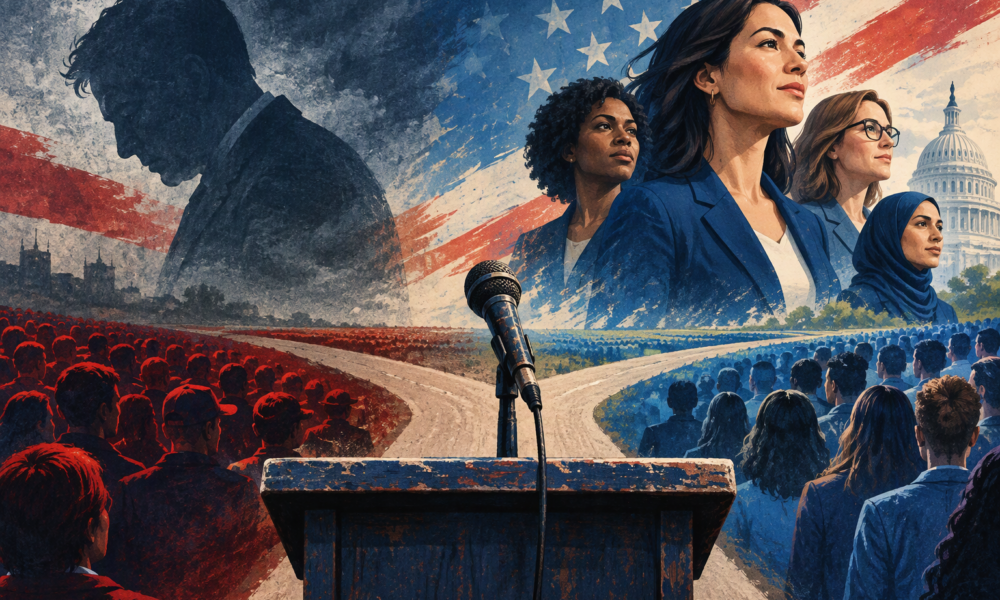
Women candidates do not automatically represent moderation, competence, or peace. They must earn those descriptions through policy and performance. But Trump’s style has made contrast more valuable. A woman who speaks firmly without turning every disagreement into a personal war can stand out. A woman who shows command of foreign policy without treating military force as a branding exercise can stand out. A woman who can criticize her own party, negotiate across factions, and explain tradeoffs can stand out.
This is not about electing women as a symbolic correction. It is about voters searching for a different political vocabulary. After years of masculine political theater, “serious,” “prepared,” “calm,” and “accountable” may become more powerful campaign words than “strongman” and “fighter.”
Women who could shape the 2028 conversation
No one should confuse public speculation with a declared campaign. Still, several women are already part of the national conversation:
- Gretchen Whitmer: A Democratic governor with executive experience and a record that could appeal to voters looking for a practical governing contrast.
- Kamala Harris: A former vice president whose supporters may argue that the country deserves another serious look at her experience and coalition.
- Alexandria Ocasio-Cortez: A national progressive communicator with an unusually strong ability to turn political arguments into movement energy.
- Elissa Slotkin: A national-security voice whose profile could grow among voters who want toughness paired with institutional discipline.
- Sarah Huckabee Sanders: A Republican governor who could test whether conservatives want a post-Trump successor without abandoning the party’s cultural base.
- Elise Stefanik: A prominent Republican national figure whose future would reveal whether the party rewards loyalty to Trump or independence from him.
Other names will emerge, and some of these figures may never run. The important point is not prediction. It is competition. A crowded field gives women more chances to define what leadership looks like after Trump fatigue sets in.
The real lesson for white male candidates
White men are not disqualified from the presidency. But the easiest version of their political path has been damaged. A candidate who relies on inherited identity, grievance, and imitation will struggle to explain why voters should choose him over the original performer. The stronger route is reinvention: competence over chaos, persuasion over humiliation, and service over spectacle.
Trump may have helped create an opening for women, but women will have to use it. They will need clear policies, credible records, strong organizations, and the willingness to resist both sexism and the temptation to copy the same politics they are trying to replace.
Trump fatigue is not a guarantee of a female president. It is a warning to every candidate who believes volume is the same as leadership. The next winning message may come from the person who can make voters feel that the country is finally ready to move forward.
Editorial note: This is political opinion, not a prediction of the 2028 field. Candidate names reflect public discussion as of November 23, 2026, and none should be treated here as a declared nominee unless they formally announce.