NARUC's Tony Clark Guards State Rate Authority as Democrats Weigh Federal Data Center Pricing – Broadband Breakfast

Should the Federal Energy Regulatory Commission have 'sole authority' over retail rates for data centers above 50 megawatts?
WASHINGTON, Nov. 28, 2026 – A bill from Rep. Greg Landsman, D-Ohio, would strip state utility commissions of the power to set retail electric rates for large data centers and hand it to federal regulators. The man who now represents those commissions has held both jobs.
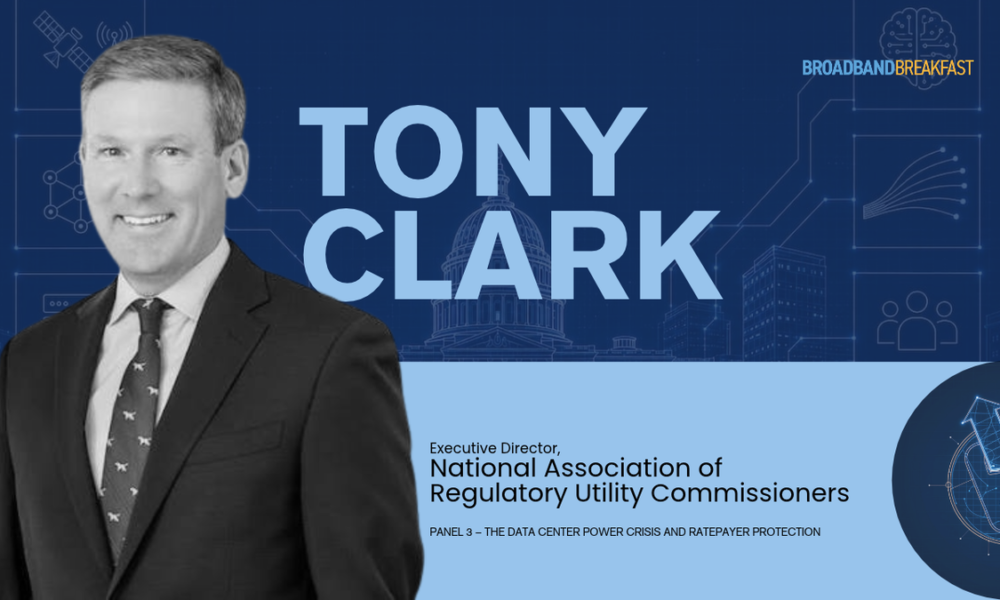
As executive director of the National Association of Regulatory Utility Commissioners, the national group for state utility regulators, Tony Clark speaks for those commissions. He spent 11 years on North Dakota’s commission and four at the Federal Energy Regulatory Commission, the federal grid regulator. He joins the 1:30 p.m. Dec. 1 panel “The Data Center Power Crisis and Ratepayer Protection,” moderated by Lauren Feiner, senior policy reporter at The Verge.
From 2001 to 2012, Clark served on the North Dakota Public Service Commission, more than five years as chairman, and he led NARUC in 2010 and 2011.
He then sat on FERC from 2012 to 2016, so he has set retail rates as a state regulator and wholesale grid rules as a federal one. NARUC named him its top staff executive in August 2024, he took over Jan. 1, 2025, and on May 13 he carried the association’s case to a House energy panel.
The No Harm Data Centers Act, H.R. 8033, introduced March 20, would give FERC “the sole authority to approve rates and charges for the retail sale of electric energy” to data centers with peak demand above 50 megawatts. Those rates would have to cover the full cost of grid upgrades. Cooperatives, city-owned utilities and the Tennessee Valley Authority would be exempt.
The House took a lighter path in September. It passed the Ratepayer Protection Act, H.R. 9340, 417 to 3, directing states only to “consider” full-cost rules for loads above 100 megawatts. Senate Democrats then blocked it 57 to 43, Broadband Breakfast reported.
NARUC’s board drew its line Nov. 11, 2025. A resolution urged FERC “to preserve and affirm states’ retail regulatory authority under the Federal Power Act” as it weighed an Energy Department proposal on connecting large loads to the grid.
In May 13 written testimony to the House Energy Subcommittee, Clark warned of “a potential unprecedented assertion of federal jurisdiction over certain large load retail interconnections.” He added, “States oversee the one aspect of rates that customers care about most: the bills they pay.” The testimony did not name Landsman’s bill.
States are writing their own rules. By March, the Smart Electric Power Alliance, a nonprofit that researches utility practices, counted 77 large load tariffs pending or in place across 36 states, Utility Dive reported.
In Ohio, regulators approved a tariff from the utility AEP Ohio in July 2025. New data centers above 25 megawatts must pay for at least 85 percent of their subscribed capacity for up to 12 years, regardless of actual use.
Also on the panel are Cy McGeady of the data center company Equinix, Josh Levi of the industry trade group Data Center Coalition and Tashia Roberson-Wing of Landsman’s office.
Sign up for Broadband and AI in the Next Congress on Dec. 1.
Already have an account? Sign in
Already have an account? Sign in
Before joining the data center company, he co-wrote a think tank report backing federal money for shared grid upgrades
Her framework would license AI companies, split AI from Big Tech platforms and put union and public-interest seats on boards
Landsman has backed bipartisan legislation to speed broadband construction
Ford's rural broadband group endorsed the Senate permitting bill, then pressed the FCC for local permit deadlines
Better Broadband, Better Lives
Published with Ghost.