Europe Today
Euronews' flagship morning TV show with the news and insights that drive Europe, live from Brussels every morning at 08.00. Also available as a newsletter and podcast.
The Ring
The Ring is Euronews’ weekly political showdown, where Europe’s toughest debates meet their boldest voices. In each episode, two political heavyweights from across the EU face off to propose a diversity of opinions and spark conversations around the most important issues of EU affairs and the wider European political life.
No Comment
No agenda, no argument, no bias, No Comment. Get the story without commentary.
My Wildest Prediction
Dare to imagine the future with business and tech visionaries
The Big Question
Deep dive conversations with business leaders
Euronews Tech Talks
Euronews Tech Talks goes beyond discussions to explore the impact of new technologies on our lives. With explanations, engaging Q&As, and lively conversations, the podcast provides valuable insights into the intersection of technology and society.
The Food Detectives
Europe's best food experts are joining forces to crack down on fraud. Euronews is following them in this special series: The Food Detectives
Water Matters
Europe's water is under increasing pressure. Pollution, droughts, floods are taking their toll on our drinking water, lakes, rivers and coastlines. Join us on a journey around Europe to see why protecting ecosystems matters, how our wastewater can be better managed, and to discover some of the best water solutions. Video reports, an animated explainer series and live debate – find out why Water Matters, from Euronews.
Climate Now
We give you the latest climate facts from the world’s leading source, analyse the trends and explain how our planet is changing. We meet the experts on the front line of climate change who explore new strategies to mitigate and adapt.
Europe Today
Euronews' flagship morning TV show with the news and insights that drive Europe, live from Brussels every morning at 08.00. Also available as a newsletter and podcast.
The Ring
The Ring is Euronews’ weekly political showdown, where Europe’s toughest debates meet their boldest voices. In each episode, two political heavyweights from across the EU face off to propose a diversity of opinions and spark conversations around the most important issues of EU affairs and the wider European political life.
No Comment
No agenda, no argument, no bias, No Comment. Get the story without commentary.
My Wildest Prediction
Dare to imagine the future with business and tech visionaries
The Big Question
Deep dive conversations with business leaders
Euronews Tech Talks
Euronews Tech Talks goes beyond discussions to explore the impact of new technologies on our lives. With explanations, engaging Q&As, and lively conversations, the podcast provides valuable insights into the intersection of technology and society.
The Food Detectives
Europe's best food experts are joining forces to crack down on fraud. Euronews is following them in this special series: The Food Detectives
Water Matters
Europe's water is under increasing pressure. Pollution, droughts, floods are taking their toll on our drinking water, lakes, rivers and coastlines. Join us on a journey around Europe to see why protecting ecosystems matters, how our wastewater can be better managed, and to discover some of the best water solutions. Video reports, an animated explainer series and live debate – find out why Water Matters, from Euronews.
Climate Now
We give you the latest climate facts from the world’s leading source, analyse the trends and explain how our planet is changing. We meet the experts on the front line of climate change who explore new strategies to mitigate and adapt.
For years, the Republican Party’s message on technology was straightforward: cut regulation, unleash private investment and let US businesses build. But as the 2026 midterm elections approach, one unlikely issue is threatening to complicate that formula: data centres.
The enormous facilities needed to power the artificial-intelligence boom have become a political liability for Republican candidates in some of the country’s most competitive races – precisely because US President Donald Trump remains one of their most enthusiastic defenders.
Trump has been unequivocal in his support. In recent comments, he argued that communities resisting data centres are “making a mistake”, and said governors and mayors should want AI facilities because of the jobs, investment and tax revenue they bring.
He has repeatedly framed the expansion of data centres as essential to defeating China in the global AI race – and downplayed the mammoth amount of electrical power needed to run the centres and the impact they have on neighbouring areas.
“They’re making their own power plants. They’re building the most beautiful, you’ve never seen power plants like this,” Trump said in an interview that aired on Sunday.
His zeal for data centre construction puts Republican candidates in an awkward position. They are being asked to defend an administration that sees AI infrastructure as a pillar of American economic and national security – while voters in their own states are increasingly asking a much more basic question: Who is going to pay for all of this?
Data centres consume not only enormous amounts of electricity, but also, in many locations, substantial quantities of water. Residents worry about higher utility bills, pressure on local power grids, noise, pollution and the loss of farmland or open space. The economic benefits can be substantial, but so can the infrastructure costs.
And the backlash is no longer confined to the political left.
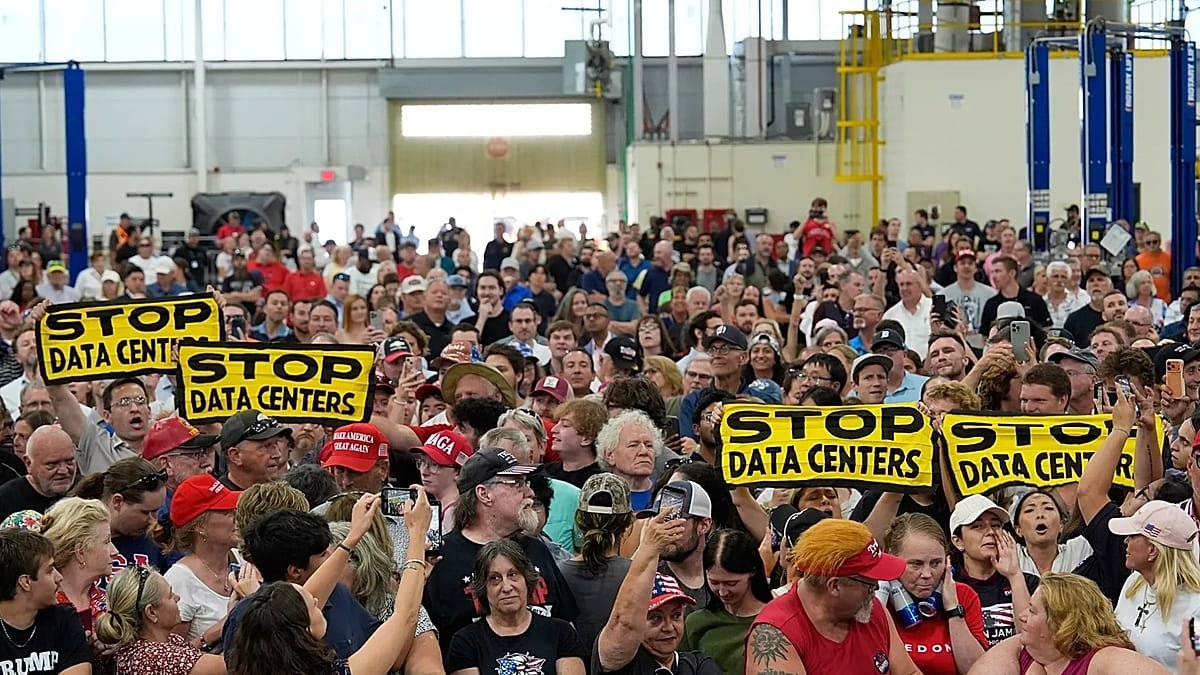
A recent Gallup survey found that roughly seven in ten Americans oppose having a data centre built in their own community, including a majority of Republicans. That has transformed what was once largely a zoning and planning dispute into a national political issue.
For Republicans, the problem is particularly acute because the issue cuts directly across one of the party’s defining political instincts: support for business coupled with opposition to government intervention.
The Republican candidate who says “build it” risks sounding like an ally of Big Tech at a moment when voters are increasingly skeptical of the industry’s power, but the Republican who says “stop it” risks contradicting Trump and undermining the administration’s broader campaign to make the US the world’s dominant AI power.
Nowhere is that tension more obvious than in Ohio, the home state of Vice President JD Vance. The National Republican Senatorial Committee, which is responsible for coordinating the party’s US Senate campaigns, has privately warned AI companies that the public image of data centres has become so toxic that it could threaten Republican chances of holding the crucial Ohio Senate seat.
Democratic candidate Sherrod Brown has seized on the issue, portraying incumbent Republican Senator Jon Husted as closely associated with the data centre industry. A Republican campaign memo reportedly warned that the issue could become a “sleeper” problem for the entire election cycle.
And some Republicans are feeling the heat.
Last week, Mike Rogers, the Republican running for Senate in the key swing state of Michigan, said that he now supports a one-year moratorium on data centre construction. The irony is striking: Trump’s AI strategy may be creating a political problem for the very Republicans who need his support most.
The administration has tried to square the circle. Trump has acknowledged that Americans should not be forced to shoulder the costs of the AI boom, and in March, the White House brought major AI companies together to sign a voluntary “Ratepayer Protection Pledge” intended to ensure that households would not bear higher electricity costs caused by data-centre expansion.
But politically, that may not be enough. Voters are not necessarily opposed to AI itself. Many are attracted to the promise of new jobs, technological leadership and investment. Their objection is increasingly about who gets the benefits and who absorbs the costs.
That distinction is giving Republican candidates a narrow escape route. Rather than opposing data centres outright, Republicans in vulnerable races are increasingly calling for developers to pay for their own electricity, protect local communities and obtain local consent.
Texas Governor Greg Abbott – once a strong champion of the state’s AI and data-centre expansion – has become increasingly critical of the industry, accusing developers of having “dug their own grave” by failing to win public support.
But even that position puts Republicans in uncomfortable opposition to Trump. The president has made clear that he does not want local resistance to derail America’s AI ambitions. He sees data centres not simply as commercial real estate, but as strategic infrastructure in a technological contest with China.
The White House has therefore pushed to accelerate permitting and construction of AI data centres and the transmission infrastructure required to power them.
This creates a potentially explosive political contradiction. Trump is telling America to build faster. Republican candidates in battleground states are discovering that their voters want them to build more carefully, or sometimes not at all.
Democrats are beginning to recognise the opportunity. The data-centre fight allows them to attack Republicans from an unusual angle: not as opponents of capitalism, but as defenders of consumers against what they portray as unchecked corporate power.
In competitive states, Democratic candidates can argue that ordinary households should not have to pay higher electricity bills so that technology companies can build the infrastructure for the next generation of AI.
That argument is particularly potent because it connects an abstract debate about artificial intelligence to something voters understand immediately: their monthly utility bill.
The political geography is also changing. What once looked like a classic culture-war issue is becoming a local economic populist issue – and that makes party labels less reliable.
Republicans who have spent years railing against federal overreach are suddenly confronting constituents who want government to stop a private company from building a giant industrial facility nearby.
Democrats who traditionally welcomed clean-tech and infrastructure investment are finding themselves campaigning against some of the world’s biggest technology companies.
At the congressional level, the result is a rare bipartisan backlash. But for Trump, backing away is difficult. His broader political and economic strategy depends on portraying the US as the global leader in AI. That requires electricity, chips, transmission lines and, above all, enormous computing facilities.
So the president has chosen to double down, leaving Republican candidates with a delicate balancing act heading into November: embrace Trump’s AI revolution without becoming the face of the data-centre boom in their own communities.
For some, that may be possible by demanding that technology companies pay their own way. For others, particularly in hotly contested Senate and governor’s races, the issue could become a political minefield.
The emerging lesson is that the AI revolution may not be defeated by voters who fear artificial intelligence. It may instead be slowed by voters who simply do not want an enormous data centre in their backyard – especially if they believe they are the ones paying for it.
And that is precisely why the issue has become so uncomfortable for Republicans. Trump sees data centres as the factories of America’s technological future – but Republican candidates are discovering that their voters see them as the factories next door.
 Browse today's tags