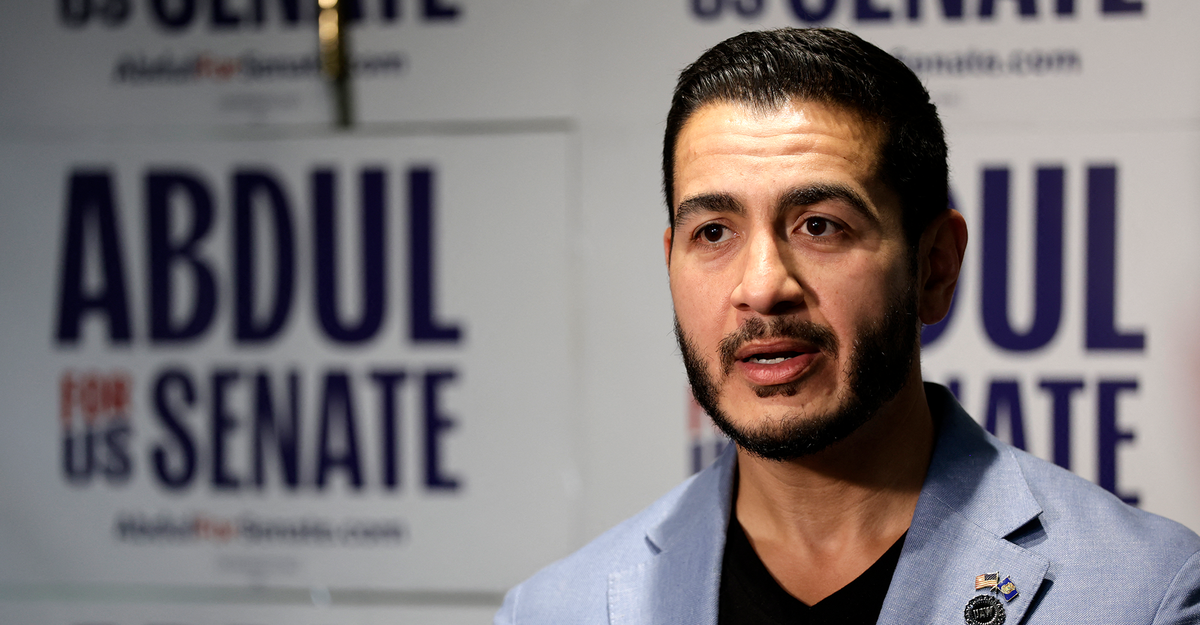
The Senate election presents liberals with a grim choice.
The hard-left Twitch streamer Hasan Piker warned Jewish Americans last week that their excessive identification with Israel would subject them to anti-Semitic attacks. “If Jews in America keep putting this idea out there that they are singularly invested in Israel, eventually someone is going to come around and take action—not against the state of Israel, mind you, but against American Jews,” he said. Piker’s tone was one of rueful concern, not unlike the pose adopted by anti-Semites throughout history. “No person with a sense of the dignity of mankind can condone the persecution of the Jewish race in Germany. But no person of honesty and vision can look on their pro-war policy here today without seeing the dangers involved in such a policy both for us and for them,” the Nazi sympathizer Charles Lindbergh said in 1941.
Several leading Democrats, including Senator Elissa Slotkin of Michigan and House Speaker Hakeem Jeffries, issued statements denouncing Piker’s ugly warning to the Jews as a barely veiled anti-Semitic threat. Abdul El-Sayed, the Democrat running for Michigan’s other Senate seat, trod more carefully. He issued a statement “in response to Hasan Piker’s comments” affirming that “all Americans deserve the right to advocate for what they believe without fear of violence” and denouncing anti-Semitism, but the statement itself did not say whether Piker’s comment qualified as anti-Semitism. El-Sayed instead dismissed Piker as a distraction, saying at a recent rally, “The effort to make this race about a streamer in L.A. is actually kind of laughable.”
Most Democrats followed El-Sayed’s line that Piker was irrelevant. “This election is about what’s going to happen when we elect Abdul to the United States Senate. I am done, so don’t any reporter ask me again about Hasan Piker. It’s not what November is about,” Representative Debbie Dingell said at a rally for El-Sayed.
Graeme Wood: Something is happening to America’s moral code
Democrats have good reason to say this. El-Sayed is running a close race to hold a seat that Democrats probably need to retain to win control of the Senate in the midterm elections.
But the truth is that Piker, and the uncomfortable questions raised by his alliance with El-Sayed, is one of the important questions at stake in the election. If Piker were just an internet pundit, his rant—the latest entry in a long list of outrageous comments he has made—would be of little consequence to the Democratic Party. Piker has said that “America deserved 9/11,” praised Mao Zedong as “one of the great leaders of this world,” and mourned the collapse of the Soviet Union as “one of the greatest catastrophes of the 20th century.” His ideology is profoundly authoritarian. But several left-wing Democrats, especially El-Sayed, have campaigned with Piker and elevated him into one of their most prominent surrogates. So El-Sayed’s alliance with Piker has become a political and moral crisis.
In Michigan, Democrats are trying to avoid handing Republicans their first Senate win in the state in more than three decades. But if El-Sayed wins, he would throw open the doors of the party to a strain of militant politics that many Jews justifiably consider dangerous. The Democratic Party is now divided between those who are trying to force El-Sayed to stop encouraging left-wing anti-Semites and those who give him their unconditional support.
The Michigan Senate election has presented liberals with a grim choice. The Republican candidate, Mike Rogers, has pledged support for a corrupt, racist, authoritarian-minded administration. Rogers hasn’t made even the tiniest concession to Donald Trump critics. But supporting El-Sayed means accepting a strain of anti-Semitic politics that to date has had no place within the Democratic Party.
What’s more, El-Sayed has already said that he intends to use his victory as a platform to reshape the party. Him winning could invite a future in which the United States has not just one party that is open to bigots but two.
Although El-Sayed has never said anything nearly as inflammatory as the sorts of comments Piker makes routinely, his mixture of anti-Zionism and populism treats pro-Israel activism as a nefarious and all-pervasive force. He has denied that any Democrat who believes in human rights could have any motive other than money for holding a position on Israel different from the one he prefers. El-Sayed tends to depict nearly all opposition to his candidacy as financially driven, but when applied to Jewish political activity, this charge becomes even more conspiratorial.
Ann Arbor, where El-Sayed lives, is home to a branch of the Free Palestine movement that has engaged in violent intimidation of Jewish Democrats. Activists at the University of Michigan not only seized the central campus grounds for their own but also vandalized the business of Jordan Acker, a Democratic regent, and made middle-of-the-night attacks on his home, one of which involved shattering his window with a jar of urine.
El-Sayed has campaigned on the Michigan campus with Amir Makled, a lawyer who defended the protesters and who has shared anti-Semitic and pro-Hezbollah social-media posts. When the Justice Department charged eight of the protesters—one of whom had worked on El-Sayed’s campaign—in a plot to commit still more acts of intimidation, El-Sayed treated the indictment as biased, telling reporters, “It’s a lot more about what you’re advocating for that gets you indicted or not indicted, rather than what you did.”
Dana Nessel, the state’s attorney general, has faced anti-Semitic harassment and has said that she plans to skip the state party’s August convention rather than endure more abuse. At the party’s April nominating caucus, Mallory McMorrow, a then-candidate for Senate, reported that her Jewish husband was subjected to an anti-Semitic slur. On the weekend before the primary, Walter Masterson, a left-wing streamer who has appeared with El-Sayed, disrupted an event for Haley Stevens, El-Sayed’s pro-Israel opponent in the Democratic primary, forcing the brewery hosting it to cancel the event. El-Sayed did not condemn the bully-boy tactics used on his behalf.
Before he warned American Jews that they were bringing anti-Semitism on themselves by identifying with Israel, Piker displayed on his Twitch stream a quote attributed to Jeremy Moss, the Democratic nominee for Congress in a suburban Detroit district: “The entire purpose of my campaign is to make sure America continues to support Israel. I don’t think it’s wrong for Jews in America to want to put Israel first. America is not our homeland and we have been victims of antisemitism here.” Moss insists that the quote is a pure fabrication, and no one has yet produced any evidence of its authenticity.
Numerous Democrats denounced Piker’s comments. Instead of apologizing, though, Piker replied on X, “Aipac boss call was made,” implying that only the influence of the pro-Israel lobby could have caused Democrats to object to his rhetoric.
James Loeffler: The hatred that broke American politics
El-Sayed has refused pleas from his fellow Democrats to break off his alliance with Piker, who joined him at a pool party on the last day of campaigning before the primary. El-Sayed first brushed off the requests by likening Piker to Joe Rogan, a controversial podcaster whose show some Democrats have appeared on (but not a figure they have brought out on the campaign trail). More recently, he argued that the demands that he distance himself from Piker come from “cancel culture that all of us agreed was a bad idea back in 2020, but we seem to want to bring it back.”
This is a dodge. El-Sayed’s fellow Democrats are not trying to silence or punish Piker. They are asking El-Sayed, who chose to bring Piker out to campaign for and endorse him, to make clear where he stands. “Abdul El-Sayed had a prime opportunity to cut ties with Piker and directly disavow his words, but he did not,” Democratic Representative Hillary Scholten of Michigan told Politico. “There is a lot of work left to do to unite the party.”
Notably, El-Sayed is using an evasive construction similar to the one that J. D. Vance has employed to justify his friendship with Tucker Carlson. “We have far more important work to do than canceling each other,” the vice president told a conservative gathering last year. The reason Vance uses this deflection is obvious. He wishes to benefit from Carlson’s support without being held responsible for his ally’s most inflammatory claims. This has set off a bitter struggle within the right. Some Republicans are trying to throw Carlson out of the coalition; Vance wants to keep him in.
Democrats have little trouble understanding that the right-wing infighting over Carlson is about whether the Republican tent, which already includes racists, nativists, and vicious Islamophobes, is also big enough to include anti-Semites. They have correspondingly little trouble making harsh judgments about the moral compromises Republicans are contemplating in the process.
What many Democrats don’t wish to admit is that they are entertaining a similar choice themselves. El-Sayed and Piker have professed their abhorrence of anti-Semitism. But so has Vance—and, so, for that matter, has Carlson. If your opposition to anti-Semitism applies only to your ideological adversaries, and you excuse or ignore it from your allies, it is an empty bromide.
When Democrats dismiss the controversy over Piker and the movement he stands for, they are treating the growing influence of left-wing anti-Semitism as unworthy of concern—or, worse still, a fait accompli. The Democrats imploring El-Sayed to renounce Piker want more than a generalized promise to safeguard Jewish safety, or a statement that “nobody” speaks for the candidate. They are seeking some assurance from El-Sayed that he will speak out in opposition to attacks against Jews by his own supporters.
El-Sayed has responded as if the only reason Democrats might hesitate to endorse him is that they hold a personal grudge against him. “There are a few people who are still nursing wounds or grievances from the primary,” he told Semafor. “I get it. Losing is hard.” It is true that losing elections is hard. Losing your moral principles, on the other hand, can be surprisingly easy.
TheAtlantic.com © 2026 The Atlantic Monthly Group. All Rights Reserved.
This site is protected by reCAPTCHA and the Google Privacy Policy and Terms of Service apply