You’re reading The TNR Blue Book. Get daily scoops, strategy, and developments inside the liberal ideas factory delivered right to your inbox. Sign up for free.
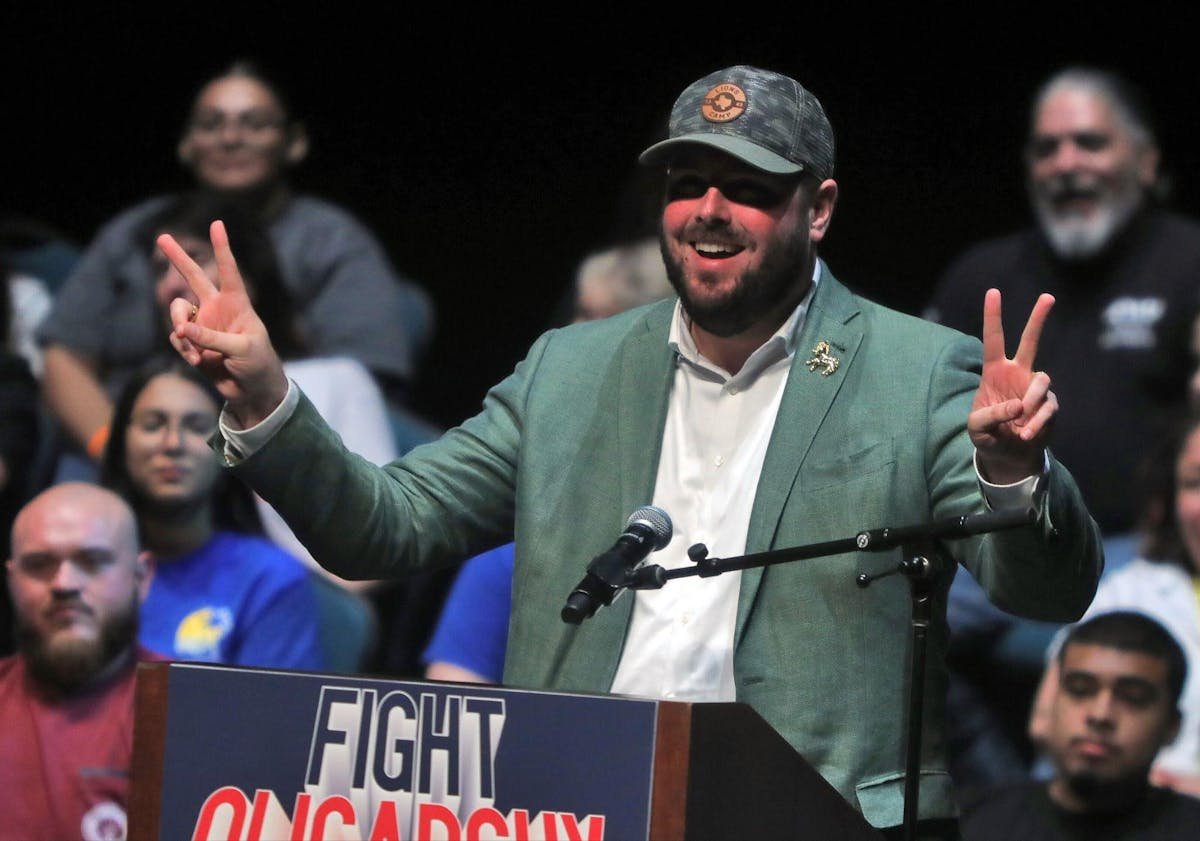
Kendall Scudder has his work cut out for him. He became chair of the Texas Democratic Party in March 2025, inheriting a party in debt that just five months later had to contend with state Republicans’ mid-decade redistricting, which aimed to net the party five more House seats in the 2026 midterms. He has also had to navigate a contentious Senate primary between U.S. Representative Jasmine Crockett and State Representative James Talarico, which the latter won.
In addition to those headaches, Scudder created one of his own by restructuring the party’s operations. Rather than being centralized in Austin, staff are now distributed across Austin, Dallas, Houston, Eagle Pass, and Amarillo. Some staff quit as a result. But the shake-up apparently was popular with the party’s delegates, who overwhelmingly reelected Scudder as chair in June.
We spoke Thursday about the state of the Texas Democratic Party today and what the future—near and far—holds.
Is it mostly rural areas where you’re trying to expand the map? Are you focusing on suburbs? What does that expansion look like?
What a lot of people from outside of Texas don’t quite realize is, yes, we are geographically very large. We have some of the largest cities in America, many of them here in Texas. They are mega-metros, and so what that means is that you end up with what we consider midsize cities that, in other states, are considered their population centers. Lubbock, Texas, has more people in it than Richmond, Virginia. If I have to prioritize out, [I would focus] on those midsize city population centers that often have never been worked, may not have even had county chairs, precinct chairs, and [would start] to build the party out. So we have to walk and chew gum in a state like Texas.
When I became chairman, we were up to our eyeballs in debt. Only a third of our precinct chairs were full. About 20 percent of our county chair spots were vacant. We left 27 seats uncontested on the last ballot, and the last coordinated campaign was only $2 million. And if you flash-forward 18 months, we’re a debt-free party that has a $30 million coordinated campaign. We’ve recruited and trained more than 1,000 precinct chairs. We’ve recruited Democrats in every state and federal office.
You are trying to build something that’s going to last beyond this year. Do you have a timeline in your head?
You can’t flip a state the size of Texas overnight. But I think that the deadlines are set for us. Redistricting comes in 2030. We all know the population allocation that’s happening after that—Texas is going to gain a bunch of members of Congress. A lot of blue states are losing some members of Congress. If Texas is not competitive and in play by 2032 for a presidential election, then you won’t have a Democratic president. It’s that simple.
I want to talk about the Senate race. Beto O’Rourke came really close in 2018, but he didn’t ultimately win. What does Talarico have to get over that last little hump that Beto didn’t?
Beto had to do it all on his own. Not to harp on how important a state party is, but Beto didn’t have one, really. He literally didn’t even operate on our voter file because he couldn’t trust the voter file. What Talarico has is an apparatus now that, while it is not perfect and it is certainly underfunded, it is one that sets reasonable expectations, meets them, understands its role, and builds a coordinated campaign and raises resources to accomplish that.
The demographics are constantly shifting in this state. I think a lot of Hispanic Texans feel like they were lied to, because they were, and that is a real ticket to flipping Texas: the Mexican American vote, and no one has really been able to tap into that.
Some people are still saying that Jasmine Crockett, even though she endorsed Talarico, hasn’t really put her full support behind him. Do you think she needs to get more enthusiastically behind him?
I’m not one to tell anybody what they need to do. What I will say is that it is the responsibility of James Talarico to earn every vote in this state that he can, and I think he’s up to the challenge to do that. And do you remember the last time we had a raucous primary in Texas?
You tell me.
It was 1990, the year I was born. It was Ann Richards, the state treasurer, running against Mark White, a former governor, running against Jim Mattox, the attorney general—they were all running against each other for governor in the [Democratic] primary. They went around the state literally calling each other crackheads. It was one of the nastiest primaries in American history. Do you know what happened that November? Democrats won because Democrats spent tons of money in their primary, mobilizing their base, making sure they were conscious, paying attention to what was happening and turning them out to vote.
Democrats had really led the message on data centers, and then all of a sudden, we’ve seen Ken Paxton and Greg Abbott come out against data centers. Have they neutralized the Democratic advantage here?
Let’s be clear about where Abbott stood on data centers. He did not come out against data centers. He came out in favor of not making a decision on them until after the election. And you’re talking about a governor that’s already given them $1 billion of your taxpayer dollars to come here and build. He can try to run, but he can’t hide.
What’s happening is they’re understanding how much those types of issues impact the willingness of rural Texans to support them. Data centers are an issue in rural Texas. If [the Republicans] don’t have large turnout in rural Texas, they lose.
They’re full of shit. Everyone knows it. I know it. Voters know it.
—Emma Janssen
The Michigan Senate race, and progressive Democrat Abdul El-Sayed in particular, is getting the lion’s share of attention right now, but there are other important midterm elections in the Midwest. Big seats in Ohio are up for grabs: In the governor’s race, most polls show that Democrat Amy Acton, who served as the state’s health director at the start of the Covid-19 pandemic, has a narrow lead over Vivek Ramaswamy, the billionaire failed presidential candidate. And former Senator Sherrod Brown is ahead in his bid to defeat Senator Jon Husted, who filled JD Vance’s vacated seat.
But polls show both races tightening, and Acton in particular has responded by repeatedly breaking with progressives, either as a bid to shore up her lead or to anticipate lines of attack from the well-funded Ramaswamy campaign. Late last month, she angered many on the left and in the LGBTQ community by saying she would uphold Ohio’s ban on transgender women competing in women’s sports. This month, her focus has turned to other areas. On August 10, Acton announced her support for a ballot measure that would enshrine the state’s voter ID requirement in its Constitution. And on Tuesday, she said she would cooperate with ICE as governor. “We always work with the federal law enforcement, and we will do so—whatever it takes to keep Ohioans safe,” Acton said. The comments go further than Brown’s efforts to assure voters he is not an “Abolish ICE” Democrat. (“I think for sure we need rules around ICE,” he said in a statement earlier this year, disavowing the “Abolish” wing without making his position entirely clear.)
So much of the media’s focus is on the rise of progressive left, but Brown and Acton show where most of the party still stands: attempting to triangulate and win over conservatives and Republicans, particularly in states like Ohio that lean red.
—Alex Shephard
Inflation has eased, and real wages are growing again. So why do Americans remain pessimistic about the economy? Erik Hurst and Christina Patterson, economics professors at the University of Chicago’s Booth School of Business, posit one theory at VoxEU, the policy site of the Centre for Economic Policy Research: Workers haven’t regained what they lost when inflation was rampant. Analyzing payroll records from 2016 to 2025, they found that “many workers have experienced a lasting reduction in their purchasing power.” When inflation was high, companies nonetheless gave workers standard raises of 2 percent–4 percent, rather than higher raises that accounted for inflation, so workers’ purchasing power fell and caused “a lasting hole in real pay.” That’s why workers are still sour, even though inflation peaked in 2022. The solution? Businesses should systematically index wages to inflation.
The biggest loser of the midterm elections this year is clear: pollsters. In one state after another—notably in Democratic primaries in Wisconsin and Michigan—the polls have largely failed to forecast the eventual vote. Part of the reason can be traced to the rise in recent years of so-called online opt-in polls. These are much easier and cheaper to produce than traditional phone polls but are rife with issues—in particular “bogus respondents,” as the Pew Research Center calls “survey-takers who make no effort to answer questions truthfully and instead are just looking to finish surveys quickly and collect rewards.” In a report released Thursday, the organization details how pollsters try to correct for this problem but concludes, alas, that there is no easy (read: cheap) fix.
—Ryan Kearney
Good week: Everton Blair
Blair, a 34-year-old former teacher, made history in a number of ways by winning a special election Tuesday in Georgia’s 13th congressional district. He will be the third openly gay Black person ever elected to Congress—and the first from a Southern state. He’s also the first gay person ever elected to Congress from Georgia. His time in office will be short, sadly, as he’s only serving out the rest of the late Representative David Scott’s term this year. (A different Democrat won the primary to serve the 13th next year.)
Bad week: Pete Hegseth
Actually, Trump’s secretary of defense has had two really bad weeks. Last week, he covered up the real reason the beleaguered USS Lincoln wasn’t resupplied. This week, The Washington Post reported that he may have fired the Army’s chief of staff over the probe into the flyby at Kid Rock’s estate, while The New York Times revealed the massive leadership vacuum at the Pentagon as a result of Hegseth’s firing spree against anyone competent in his midst.
Political Trivia Question of the Day
On this March on Washington anniversary: Who were the two civil rights and labor leaders who organized the rally? (Sign up for The TNR Blue Book to find the answer in Tuesday’s newsletter.)
You’re reading The TNR Blue Book. Get daily scoops, strategy, and developments inside the liberal ideas factory delivered right to your inbox. Sign up for free.
Kamala Harris has been flexing her political power in the South this year, most recently with her general election endorsement of a long-shot House candidate in Arkansas, raising the question of whether the former vice president’s goal is to rack up wins in 2026—or lay the groundwork for another White House bid in 2028.
Harris on Wednesday endorsed Democratic nominee Chris Jones, an MIT-trained physicist and minister running in Arkansas’s 2nd congressional district, which includes parts of Little Rock. It’s considered by far the most likely Arkansas district to flip blue this year, as evidenced by the Democratic Congressional Campaign Committee’s decision to add the race to its “Districts in Play” program. But that’s not saying a lot: The district is R+8, or “Solid Republican,” according to the Cook Political Report.
The district is represented by GOP Congressman French Hill, who has held the seat since 2015. In past elections, Hill has tried to damage his Democratic opponents by linking them to women party leaders like Nancy Pelosi and Hillary Clinton. It’s no far stretch of the imagination that he could seize on the Harris endorsement to tie Jones to any of her past statements or policies that don’t play well in Arkansas.
Jones isn’t worried. “We’re not scared, we’re prepared,” he told me on Wednesday. Hill, he predicts, “is gonna send out mailers that darken my skin, as if people don’t already realize that I’m Black.”
But why is Harris wading into an under-the-radar House race where the odds are heavily stacked against the Democratic challenger? That’s unclear for now, but Jones is not the first candidate she has endorsed in the 2026 cycle. She has endorsed at least seven other candidates for Congress. She has backed two former Biden White House officials in their primary campaigns: James Martin won the Democratic nomination last week in Florida’s 21st congressional district, and Dan Koh is vying for it in Massachusetts’s 6th next week. And last week, Harris endorsed House candidate Richard Pan in his general election campaign against Republican turned independent Representative Kevin Kiley in California’s 6th congressional district. The Cook Political Report rates the district “Solid D,” and Pan is a member of the DCCC’s Red to Blue program.
Harris’s only primary endorsement for Senate was Texas’s Jasmine Crockett, who lost, but she has given general election endorsements to Abdul El-Sayed, James Talarico, Roy Cooper, and Troy Jackson. She also hit a bump earlier this month when her Fight for the People PAC encouraged voters to donate to Mary Peltola’s Senate campaign in Alaska. The National Republican Senatorial Committee immediately used the endorsement to attack Peltola, whose campaign then rebuffed the endorsement (Harris lost Alaska to President Donald Trump by 13 percentage points in 2024). Rob Sand, a Democrat running for governor in Iowa, also said he wouldn’t want Harris’s help on the campaign trail.
A person familiar with Harris’s strategy told The New Republic that more endorsements are slated to come out as early as next week.
Karen Finney, a Democratic political commentator who worked on Clinton’s 2016 campaign, doesn’t see this as evidence that Harris, specifically, is seen as potentially toxic. “I think that’s less about her and more about a broader environment,” in which ties to the Democratic establishment can harm some candidates, she said.
Jones, for his part, welcomed Harris’s support, saying that it affirms the success of his campaign so far and will direct much-needed resources to his race. The endorsement, Jones told me, “says that this campaign is one of the campaigns in the South that needs attention, resources—and by resources I mean media attention and dollars. Not to change what we’re doing, but to scale what we’re doing.”
Harris has been paying attention to the South lately, as has the Democratic Party more broadly. She swung through the region this summer, joining a back-to-school rally in New Orleans and, earlier, in Tennessee, criticizing the state’s redistricting effort as “backdoored racism.” Meanwhile, the DNC’s Rules and Bylaws Committee last month voted to recommend that South Carolina come first in the 2028 primary schedule, shifting power to the state’s Black voters.
“The South gets overlooked, and particularly Arkansas gets overlooked,” Jones said. “I’m hopeful that national Democrats have learned a lesson that you cannot ignore the South.”
Black voters, particularly in the South, have lost some of their political power as a result of the Supreme Court’s voting rights decision in April, which gave GOP-led states the green light to eliminate majority-Black districts. At the same time, the decision has galvanized Black voters, who are turning out in increased numbers this midterm season. The person familiar with Harris’s strategy said that she has been very focused on areas impacted by the Supreme Court’s decision.
Finney said Harris’s endorsements in the South could further motivate voters to show up at the ballot box. “This is an area of focus for the party, and [we’re] making it clear that we are not turning our back on the South,” she said. “In fact, we are reengaging.”
Harris is popular among Democrats in the South, and broadly; she leads some very early 2028 polls. “Whether that transfers into a 2028 campaign, who knows?” Finney said. “It’s clear that she is still someone who is popular, who people want to hear from, and care what she says and care who she endorses.”
—Emma Janssen
What’s in a name? Alaska voters may ask themselves that question in November, when faced with choosing between Democrat Mary Peltola and two Republicans, both named Dan Sullivan, to represent the state in the U.S. Senate.
The top four vote-getters in Alaska’s nonpartisan primaries make it to the general election. The fourth is yet to be determined. But what we already know about the race is likely causing headaches in the campaign headquarters of incumbent Senator Dan S. Sullivan. Election officials confirmed this week that Dan J. Sullivan, a fellow Republican and retired teacher, had qualified for the general election. Peltola, who would be the first Democrat to represent Alaska in the Senate since Dan Begich lost a reelection bid in 2015, holds a narrow lead in most polls, so the last thing that Dan S. Sullivan needs is confusion over his identity in November. He’s got bigger problems than a doppelgänger, after all—like Trump’s trade war with Canada, which shares a 1,500-mile border with Alaska. But Sullivan did get a boost last weekend with an endorsement from a former Anchorage mayor. His name? Dan A. Sullivan.
—Alex Shephard
One of Democrats’ top bogeymen this century is back in the news: The Center for Media and Democracy’s Don Wiener reports that the Koch Industries, which you may recall from such hits as spearheading climate denialism, waging war on organized labor, and drowning our politics in dark money, is “also a major player in the data center building boom, with a $15-billion stake in the industry.” Edged Energy, a firm launched by Koch Real Estate Investments, reportedly owns seven data centers across the U.S. and has six more in the proposal or development stage, prompting opposition groups from Texas to Pennsylvania.
The Center for Law and Social Policy is out with a new report, “Access Denied: The Public Health Costs of Restricting Immigrant Benefits,” exploring how President Trump’s One Big Beautiful Bill has cut or restricted benefits to 1.4 million lawful immigrants, while his deportation machine has created an “increasingly hostile environment” that scares immigrants from seeking the benefits that are still rightfully theirs. The report shows how this not only harms health and economic outcomes in immigrant communities across the country but affects everyone in myriad ways—weakening herd immunity, reducing SNAP dollars, increasing demands on medical providers and food banks, and so on.
—Ryan Kearney
Here’s Why That’s B.S.
Is it true that Dolly Parton “really liked” Trump?
That’s what the president claims, anyway. Watch TNR’s Edie Olmsted explain how Trump’s sinking approval rating has him reaching new lows of slimy—in this case, by trying to capitalize on the tragedy of the country legend’s death this week. (This egomaniac truly makes every story about him.)
Political Trivia Question of the Day
South Carolina GOP Senator Darline Graham just won her primary, and if she wins the general, will go from being an appointed senator to an elected one. Question(s): How many current senators were originally appointed to their seats, and who is the most recent Democrat to fit this description? (Sign up for The TNR Blue Book to find the answer in Friday’s newsletter.)
You’re reading The TNR Blue Book. Get daily scoops, strategy, and developments inside the liberal ideas factory delivered right to your inbox. Sign up for free.
In the past few days, the Trump administration has handed Troy Jackson not just one political gift, but two. And it could prove critical to his campaign to unseat Republican Senator Susan Collins—a necessary result if the Democrats are to stand any chance of flipping the upper chamber in the November midterm elections.
Vice President JD Vance traveled to Maine on Monday to campaign for former Governor Paul LePage, who is running in the state’s 2nd congressional district, and made several rhetorical mistakes. One was his comment on a fatal Immigration and Customs Enforcement shooting in the state last month. To Mainers who are “so worried about that situation,” Vance said about the killing of 25-year-old Johan Sebastián Durán Guerrero, they ought to “have a little bit of perspective.”
Jackson was quick to respond in a video posted to X. “JD Vance is a dirtbag,” he said. “There’s a young man that had a Social Security number, he had a job, I mean, he had a life, he had a family. To come in here and say, ‘Have some perspective,’ you ought to have some damn perspective. You don’t even know what the hell is going on.”
Jackson senses, perhaps rightly, that defending immigrants and criticizing an unpopular White House is a winning strategy in the blue state. Even before Guerrero’s death, Collins had come under fire for her vote to fund ICE. And she was notably absent from Vance’s appearance on Monday, though he apparently missed the memo about her distancing herself from the administration. He praised her—”Let’s give a shout-out to Susan Collins, who’s doing a great job!”—and mentioned that she has been to his house about six times.
The other gift to Jackson’s campaign arrived over the weekend, when Trump announced a 50 percent tariff on $20 billion worth of Canadian imports, pushing Canada to strike back with retaliatory tariffs announced Tuesday. While Collins called the tariffs a “mistake,” Jackson is working to tie Collins to that policy.
“Troy spent most of his life working along the Canadian border, so he knows how important this relationship is to Maine’s economy, and he sees Trump’s tariffs for what they are: a tax on Maine families and small businesses,” said Jackson campaign spokesperson Dan Gottlieb. “When Susan Collins was given the chance to stop Trump’s tariffs from raising the cost of groceries and everyday goods, she voted ‘no’—that’s why Mainers say she votes too much with Trump.”
Gottlieb was referring to a recent Fox News poll that found Mainers think Collins votes in line with Trump too often. That must be disheartening for the longtime senator, who has spent the past decade trying to thread the needle of garnering Republican support without associating too closely with Trump’s agenda. For example, she voted against Trump’s One Big Beautiful Bill last year. But this election could be different, given that Trump is more unpopular than he’s ever been; nearly 60 percent of Mainers disapprove of Trump.
“If she could snap her fingers and make the last ten years of American politics, especially Donald Trump, go away, I’m sure she would for a whole variety of reasons,” said Mark Brewer, a professor of political science at the University of Maine.
When Collins does have to comment on the Trump administration’s policies, Brewer said, “she tries to carefully point out how she’s different than Trump on these issues, how she’s tried to push back.” When speaking about ICE in recent months, she’s emphasized her push for agents to wear body cameras. But even talking about that can hurt her. “She has to do it carefully, because when she talks about those things, it reminds people that they exist,” Brewer noted.
That applies to tariffs, as well. The issue is of particular importance in Maine, which is literally connected to its northern neighbor: Some Mainers receive their electricity from the Canadian grid, and on Monday Ontario Premier Doug Ford suggested that Canada could cut off its electricity exports to the United States in retaliation for Trump’s tariffs. Beyond that, the new tariffs will simply make goods more expensive for consumers, at a time when prices are already high.
The race appears to be tight. The Cook Political Report lists it as a toss-up, and the most recent polls—if we can even trust state-level polls these days—show Jackson with a slight lead, though within the margin of error. We’ll see if the next polls show any bounce for Jackson in the wake of these in-kind gifts from the Trump administration.
—Emma Janssen
Pennsylvania has its own “Trump czar.” Earlier this spring, Josh Shapiro, the state’s Democratic governor, quietly hired Jennifer Higgins, who had served as acting director of U.S. Citizenship and Immigration Services, or USCIS, during President Biden’s term, as a senior adviser with an unconventional role: to help him manage his relationship with the Trump administration.
Higgins has experience with Trump. She served as associate director of the Refugee, Asylum, and International Operations Directorate at USCIS during Trump’s first term—experience that has been “highlighted” by “some rights groups” in the state, per Spotlight PA, which dug into the unconventional role in an elucidating piece on Tuesday. If that role has led to some raised eyebrows, it’s worth noting that Higgins also served as chief of staff to Biden’s director of homeland security, Alejandro Mayorkas, and was made acting director of USCIS until February of last year, when she was replaced by Trump.
Although Higgins’s work in immigration policy and with the Trump administration in particular has led to some criticism—particularly her role overseeing the first Trump administration’s “Remain in Mexico” policy—you can see why it makes sense for Shapiro, especially given that Pennsylvania has sued the federal government several times over the last year and a half over immigration policy and loss of federal funding. As other blue states struggle to fight back—and as the administration attempts to fulfill a goal of one million deportations per year—”Trump czar” is a position you may see more and more.
—Alex Shephard
Public school teachers are still woefully underpaid, earning about a quarter less than comparable college graduates working in other professions. So find the Center for Economic and Policy Research and the Economic Policy Institute in a review of 2025 federal data. The “teacher pay penalty,” as they call this income gap, was an estimated 25.2 percent last year. That’s actually an improvement from 2024, when it hit a record high of 26.9 percent—but a far cry from the early 1990s, when it hovered in the single digits before steadily plunging after the turn of the century. Teachers, being unionized, tend to receive better benefits packages than private-sector professionals, but even accounting for that, teachers’ “total compensation penalty” was 14.5 percent. The pay penalty varied from state to state, ranging from 10.4 percent in Rhode Island to a whopping 40.7 percent in Colorado. “It would be willful blindness to ignore the toll that the decades-long teacher pay penalty has had on the quality of public education,” writes Sylvia Allegretto, a senior economist at CEPR. “Regrettably, policymakers have failed to deliver sustained and effective interventions capable of mitigating—let alone substantially improving—the trends outlined in this long-running series.”
The pandemic-era expansion of the Child Tax Credit was even more important than we realized. The 2021 expansion increased the per-child credit for low- and middle-income families and helped bring poverty to a record-low 5.2 percent. But the expansion expired at year’s end, sending poverty soaring to 12.4 percent. Now a report from Brookings shows how the loss of the expansion deepened the public’s economic pessimism, which persists to this day. The University of Michigan Index of Consumer Sentiment shows a notable mood decline in the first quarter of 2022 among families with incomes below $100,000—and that the more children people had, the more pessimistic they were. “The broader lesson extends beyond the CTC,” writes Jacob Bastian, a nonresident senior fellow at Brookings. “The effects of temporary benefits may not end when payments do.… For policymakers, that means evaluating temporary programs should include not only what they provide while in place, but also what happens when they disappear.”
—Ryan Kearney
Book of the Week: Seasons of Fury: Four Families and the Rise of Islamophobia in America, by Rozina Ali
THE GIST: Seasons of Fury examines the rise of persecution, bigotry, and hate in the wake of 9/11 and the rise of Donald Trump through four disparate families. Ali’s deeply personal approach illuminates how we got to this dire moment. It also means that Seasons of Fury doubles as a kind of history of Muslim life in the U.S.
PRAISE: Jonathan Blitzer, the New Yorker writer and author of the excellent Everyone Who Is Gone Is Here, says that Seasons of Fury is “a book about immigration, race, and persecution, told in stellar reportorial detail. But it’s also a mirror that Rozina Ali skillfully holds up to force a reckoning about the kind of country we really are.”
CRUISING THE INDEX: Although most of the book is focused on the last three decades of Muslim life in America, it stretches back nearly a century in vivid, personal detail, telling the stories of how and why many Muslim immigrants came to America. It covers the rise of Immigration and Customs Enforcement, the establishment of the Department of Homeland Security after September 11, and the emergence of several right-wing, openly Islamophobic think tanks in the twenty-first century, many of which pushed culture-war battles like the one over the so-called “Ground Zero mosque” to demonize Muslims.
TNR’S QUICK CRITICAL ASSESSMENT: The rise of Islamophobia is one of the most troubling problems in the U.S. today, and Seasons of Fury captures it in all of its ugliness and danger. But it also points to a number of other trends that have helped create this poisonous moment, all of which are deftly captured by Ali: the rise of the security state, the post-9/11 mutation of America’s long-standing paranoia and racism, and the growing obsession with immigration on the right. These trends underlie the rise of Trump and predate him (at least politically). They will likely outlast him, continuing to play a pivotal role in shaping our politics.
—By Alex Shephard
Political Trivia Question of the Day
In honor of Dolly Parton, even if it’s admittedly something of a bank shot: You may remember that two Black members of the Tennessee legislature were expelled in 2023 because of protests they held on the floor over gun control—and won their seats back in special elections. What were their names? (Sign up for The TNR Blue Book to find the answer in Thursday’s newsletter.)
You’re reading The TNR Blue Book. Get daily scoops, strategy, and developments inside the liberal ideas factory delivered right to your inbox. Sign up for free.
The nationwide backlash to data centers has become so widespread that it’s even hard to find Republican politicians who openly embrace them—with the exception of President Trump, of course. So why is the Democratic nominee for governor in Wisconsin touting their benefits? It’s a question many puzzled Democrats are asking, given that the governor’s mansion is a crucial bulwark against the state’s Republican-controlled legislature.
Wisconsin has the opportunity to become “an AI and a data hub not only for the entire country, but for the entire globe,” David Crowley, who defeated progressive Francesca Hong earlier this month, said in a 2025 candidate forum. His opponent, GOP Representative Tom Tiffany, has pounced, dropping an ad last week with that quote and calling Crowley “Data Center David Crowley.” “My priority is protecting Wisconsin families, taxpayers, farmland, and water, not turning our state into a data center hub for the ‘entire globe,’” Tiffany said in a recent statement to WisPolitics.
Painting Crowley as pro–data center is a no-brainer for Tiffany, given voter sentiment on the issue. Polling suggests that voters are increasingly negative about data centers. In October, 55 percent of those asked in a Marquette Law School Poll survey of Wisconsin registered voters said that the costs of data centers outweigh the benefits. But in a poll from July, that number jumped to 76 percent. No wonder even the most pro-business Republicans, like Senate candidate Ken Paxton and Governor Greg Abbott in Texas, have come out in favor of strict regulations on data centers.
But as much as Tiffany would like voters to believe he opposes data centers while his Democratic opponent supports them, the reality is a lot more complicated.
Ultimately, the two candidates have similar policy views on data centers, as a piece in Vox laid out last week. Neither one has called for a moratorium on building them, as Hong did. Tiffany has called for rolling back a state subsidy on data centers, which Crowley hasn’t matched, but otherwise the candidates are aligned on the issue, calling for local control over construction and environmental standards to protect natural resources.
Joe Zepecki, a Democratic political strategist who lives in Wisconsin, sees Tiffany’s portrayal of Crowley’s position as an act of desperation from a weaker candidate. “Tiffany is running uphill with an 800 pound anchor on his back,” he said. “I think the fact that the Tiffany campaign chose to engage on data centers right out of the gate is because they know he has vulnerabilities.”
But the race seems to be tight: The latest polls, from mid-August, show Crowley up by three or four percentage points with over two months to go until Election Day. Crucially, the governor’s race could also affect downballot races for the state Senate and Assembly, which have been in Republican control since 2011. During that time, Republicans gerrymandered the state to their advantage. Now Democrats have the best chance they’ve had in years to take back the legislature and try to undo some of the damage the GOP has done, like a 2011 law abolishing collective bargaining for public workers. “If we don’t nominate someone who can win statewide and bring legislative majorities with them, so much of the work of the last eight to ten years is for naught, and so the stakes are enormous,” Zepecki said.
Charles Franklin, a professor of law and public policy who directs the Marquette Law School Poll, said that Tiffany’s focus on data centers could help him appeal to independents who, as his polling suggests, are against data centers at higher rates than Republicans are. He also sees Tiffany’s rhetoric as a way to connect with rural conservative voters, who make up a large part of his base, and rally them. “He just did an event yesterday in western Wisconsin, saying he was, as governor, not going to let data centers take over farmland in this lovely rural area of western Wisconsin,” Franklin said on Monday. “He’s doing it in a way that speaks to the rural parts of the state, which [are] his natural electoral constituents, even if there’s not, in fact, bulldozers coming to bulldoze your farmland.”
In response to Tiffany’s attacks, Crowley is reminding voters that Tiffany hasn’t introduced legislation restricting data centers during his time in Congress. Meanwhile, Tiffany has said that Crowley takes money from data center proponents, which is likely a reference to donations from union interests. Some unions are in favor of data centers since their members would build the infrastructure, but Zepecki cautioned against characterizing all Wisconsin labor interests as pro–data center.
The stakes of this debate feel incredibly high in Wisconsin, explained Amy Barrilleaux, the communications director at Clean Wisconsin, an environmental organization that has called for a pause on data center development. “This is not normal times,” she said. “If we don’t take a minute and understand and prepare and ask questions and get some transparency, we’re going to be looking at a state that’s really different than the state our kids grew up in.”
—Emma Janssen
Nearly two weeks after massive storms with 100 mph winds tore through Indiana, nearly 30,000 residents are still without power, with roughly a third of them in the predominantly Black city of Gary. “We’re at day twelve, and twelve days is too long for families to be without power,” the city’s mayor, Eddie Melton, said in a video posted on Facebook. “Twelve days is too long for parents to worry about their children and for businesses to lose revenue and for families to wonder when the relief is finally going to come. I want you to know I share that frustration.”
“We’re always in survival mode in Gary,” hairstylist Shatiya Hardin told the Associated Press. “And I think that’s probably why it wasn’t so much of an uproar because the first few days, it was like, ‘OK, we’re used to this…. but this is the second week now. It’s not OK for us to continually be in survival mode, doing the best that we can.”
Gary has faced decades of neglect since the collapse of its steel industry in the 1970s and ’80s, a fact many residents and outsiders believe is directly related to its status as Indiana’s only majority-Black city. Its poverty rate is roughly 30 percent, and the energy grid that failed during the early-August storm was left vulnerable in part due to a failure to do routine tree maintenance by NIPSCO, northern Indiana’s power monopoly. Indiana is one of the most gerrymandered states in the country, with only two of its nine districts viable for Democratic candidates. The state’s 1st congressional district includes Gary—and currently “leans” toward incumbent Democrat Frank Mrvan, who won his primary last week and who welcomed FEMA’s recent federal emergency declaration.
—Alex Shephard
In an issue brief for the Washington Center for Equitable Growth—the first in a three-part series—visiting fellow Mary Beech explores how weaknesses in federal data collection make it difficult to know how broadly artificial intelligence is being adopted by workers—and to what degree it is changing the labor market. “How does the adoption of AI by firms affect worker employment and unemployment, compensation, jobs lost, and job opportunities?” she writes. “As this brief demonstrates, no single data source can answer this question, federal or otherwise.” As Beech notes, there are several efforts in Congress to rectify this problem, in the form of two bipartisan bills—one sponsored by Virginia Senator Mark Warner, and one introduced by New Hampshire Senator Maggie Hassan.
Over at the Institute for Policy Studies, associate fellow Christine Ahn argues in favor of Trump’s order for the U.S. to “substantially reduce” its military drills with South Korea. “While any diplomatic overture from this administration should be viewed with skepticism,” she writes, “progressives shouldn’t miss an opportunity to take a principled position that advances peace, a reduced U.S. military footprint, and the security of the American and Korean people.” Ahn says that instead of “parroting the political establishment that benefits from forever wars, progressives should challenge … the belief that military superiority produces security, that militaristic ‘deterrence’ is stabilizing, and that allies exist for the U.S. to position them. This is not producing peace.”
—Ryan Kearney
Debru Carthan, executive vice president of Service Employees International Union-United Healthcare Workers West
Q: Who are you, and what are you working on right now?
Q: What is the most difficult thing about your line of work?
Q: What was your biggest success in the last year or two?
Q: What keeps you going in these stressful times?
Political Trivia Question of the Day
Democratic candidates are pretty well positioned to win governor’s races in both Ohio and Georgia, two states that haven’t had a Democratic governor in a while. Who were the last Democratic governors of those two states? (Sign up for The TNR Blue Book to find the answer in Wednesday’s newsletter.)
You’re reading The TNR Blue Book. Get daily scoops, strategy, and developments inside the liberal ideas factory delivered right to your inbox. Sign up for free.
Do Democrats have a chance to flip a Senate seat in Arkansas? One poll this week suggested they might—stunningly finding that Republican Senator Tom Cotton is trailing his Democratic opponent in the deep red state. Experts say not to take it too seriously: The poll is almost certainly an outlier. But, they add, there might be some useful lessons in it.
This week, Talk Business & Politics and Hendrix College released a survey of 1,217 likely Arkansas voters, finding that Democrat Hallie Shoffner, a farmer and businesswoman, was narrowly ahead of Cotton in the race for Senate. 47.4 percent of respondents said they would vote for Shoffner, and 44 percent backed Cotton. That’s a shocking result; the Cook Political Report considers the Arkansas race a “Solid Republican,” and another poll of likely voters found Cotton ahead by 16 points. Arkansas has been solidly red for around 15 years, and the last time the state elected a Democratic senator was in 2008.
So why does it look like a Democrat has a chance? One answer can be found in the nature of polling itself. “People like to sometimes call polling a prediction. It’s not a prediction, it’s a measurement,” said Robert Coon, managing partner with Impact Management Group, who helped craft the questions for the poll. The poll doesn’t necessarily reflect how Arkansans will vote on November 3, but instead captures how they feel in the present, before spending and advertising has kicked into high gear.
“There’s a ton of time between now and the general election,” said Jay Barth, a professor of politics at Hendrix College who helped design the poll. “Tom Cotton has dramatically more resources than Shoffner.”
Cotton ended June with nearly $10 million in cash on hand. Shoffner had just $864,000. In the 45 to 60 days before the election, both campaigns will likely start spending their money in earnest, putting up more TV ads and sending out mailers. According to Stephen Ansolabehere, a professor of government at Harvard University, most voters don’t start paying full attention to the candidates until at least September; it’s not unusual for earlier polls to yield some bizarre results.
So far in 2026, polls have already proven to be bad predictors of how voters actually behave in the ballot box. In Michigan’s Senate primary, polls predicted that Abdul El-Sayed would defeat Haley Stevens in a blowout. Instead, he won by just one percentage point. A similar phenomenon happened in Wisconsin’s gubernatorial primary, where Francesca Hong was widely expected to beat David Crowley by double digits according to polling; she ultimately lost by less than one percentage point.
“People definitely shouldn’t overweight what one poll says, and there will obviously be more outside polls [and] inside polls that are done,” said Coon. “Really, it’s about a trend line.”
Still, the poll suggests that independents in Arkansas are increasingly frustrated with President Donald Trump and the war in Iran. “Over the last eight election cycles, independent voters have traditionally [leaned] two to one with Republicans,” Coon explained. In this poll though, independents supported the Democratic candidate at a roughly two to one margin.
Even if Shoffner isn’t headed to a shocking win in a solidly red state, the poll still offers some useful guidance for the campaigns as they hurtle toward November. Cotton seems to be underperforming in the fast-growing Northwest Arkansas region, Barth explained. Shoffner has spent time in that part of the state, which could be paying off. But as spending increases, Cotton may put more resources into that area. Shoffner was also doing better with voters in suburbs around Little Rock than Democrats have done in past cycles. That could be because those areas are becoming more and more racially diverse and thus more Democratic, he suggested. Unsurprisingly, Cotton did well among voters 65 and older, a reliably Republican demographic in the state.
In November, independent voters will be the most important group to watch. Barth wonders whether the shifting attitudes among independents could be an early sign of the state becoming less red. “As there starts to be partisan change in a state or in a place, one of the first things we see is those independents start to kind of lean towards one party or the other,” he said. “And I think we are maybe seeing with younger voters some enhanced Democratic lean in response to frustrations with the Republican administration.”
—Emma Janssen
Xavier Becerra’s senior slump of a “campaign” for California governor continues, to sporadic outbursts of frustration from commentators. Reviewing the Democrat’s almost comically vague statements on everything from AI to gas cars to housing, CalMatters’s Jeanne Kuang notes that Becerra is practically guaranteed to “win based on Democrats’ voter registration advantage in California alone.” Political science professor Melissa Michelson tells Kuang that Becerra “doesn’t have an incentive to go out on a limb,” since the only thing he can do is “mess up.” It’s possible Becerra has taken that message a little too seriously: The Sacramento Bee’s Ben Paviour notes that Becerra has clocked “almost no public appearances” since his June primary win. Despite that, Capitol Weekly’s Dan Morain calculates that Becerra’s campaign raised $1.9 million “in the first 15 days of August” alone. While Becerra has said he’ll debate his Republican opponent, Steve Hilton, they have yet to set a date. “I still don’t really know why Becerra is running and have no expectation that I’ll get an answer before he becomes governor, or even after,” Californian policy analyst Ned Resnikoff recently wrote on Bluesky. “This is a campaign for governor. Not a coronation,” griped Mark Z. Barabak at the Los Angeles Times.
“Cities are increasingly turning to artificial intelligence to address one of the most persistent sources of housing permitting delays: incomplete applications,” reports Robbie Sequeira at Stateline. Baltimore, Denver, and Los Angeles are some of the recent converts, joining many others who have already adopted or are exploring the option. Honolulu and Seattle have both reportedly reviewed the accuracy of the permitting tool CivCheck, finding it somewhere between 87 percent and 92 percent accurate while shortening review time—but no one seems to think it can fully replace human review.
—Heather Souvaine Horn
In a new report for the Roosevelt Institute, Diana Hernandez and Lauren Ross argue that energy insecurity is no longer an issue just for low-income households, but is in fact a growing “mainstream crisis” driven not just by “rising utility rates, inflation, stagnant wages,” but also “outdated” housing stock and heating and cooling systems. Not much remains of the Bipartisan Infrastructure Law and Inflation Reduction Act, they acknowledge, but some lessons can be pulled from the wreckage. Among them: Cross-agency cooperation between bodies like the Department of Energy and Department of Housing and Urban Development better facilitates “whole-home retrofits,” which are likely to be the most effective in achieving “lasting reductions in energy consumption and improv[ing] overall housing quality.”
Damian Murphy, Allison McManus, and Andrew Miller pen an article for the Center for American Progress evaluating the Iran war at the half-year mark. The bottom line: “Six months in, Iran has emerged as the strategic victor, and the longer the Trump administration fails to reach a durable conclusion to the conflict, the more the United States stands to lose.”
—Heather Souvaine Horn
Good Week: Angie Nixon
Florida Representative Angie Nixon’s win in the U.S. Senate Democratic primary in Florida was very surprising. Her opponent, Eugene Vindman, had a massive fundraising advantage. Nixon is a Democratic Socialists of America member and Vindman from the center-left Resistance wing of the party, so this is being covered as an ideological result, another win for the surging left. That’s true. But another explanation is that Nixon is fairly rooted in Florida and the political scene there, while Vindman is more of a national, D.C., MSNBC figure.
Bad Week: Natalie Harp
It’s not just that Jon Ossoff made a quip about her that turned into days of news coverage. It’s that many of the salacious, unflattering details that emerged about Harp must have come from other people inside the Trump White House. Her enemies are not only Democrats! That said, she truly seems to have an audience of one and there is little evidence that the president wants Harp to leave his side.
—Perry Bacon
Political Trivia Question of the Day
On this date in 1858, the first of seven of these historic events took place. What events were these? (Sign up for The Blue Book to find the answer in Tuesday’s newsletter.)