Florida Democrats push to mobilize Haitian American voters ahead of midterm elections – Sun Sentinel

Daily e-Edition
Evening e-Edition
Sign up for email newsletters
Sign up for email newsletters
Daily e-Edition
Evening e-Edition
Trending:
Democrats are attempting to mobilize U.S. citizens with Haitian ancestry in Florida — home to more Haitians than any other state in the country — to vote in the midterm elections, hoping a strong showing could help power their candidates to victories.
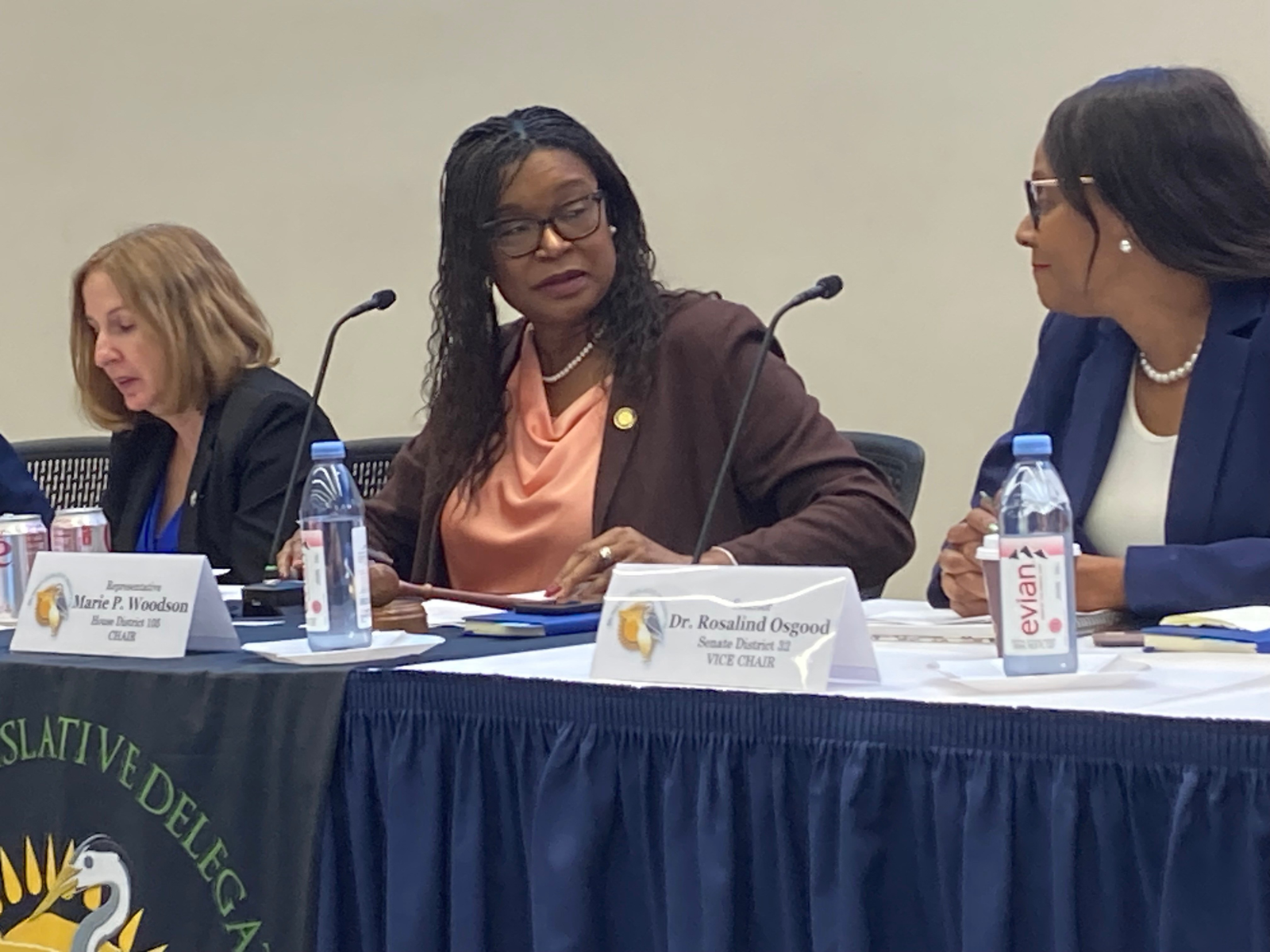
The effort is being led by state Rep. Marie Woodson of Hollywood, who was appointed by the state Democratic Party as vice chair for Haitian American voter engagement.
“I’m ready to do it. I understand my community. I understand my people,” she said. “I make it my mission not only to vote, but to make sure that everybody who is capable of voting votes. We can never get comfortable.”
Voter engagement, Woodson said, means going anywhere there is an audience and using every means of communication to reach Haitian Americans who are U.S. citizens, and thus have the right to vote, living in Florida.
Key avenues include Haitian radio, where many people get their information, and Haitian churches. Woodson declined to open her playbook. “You don’t put your plans out.”
A central challenge is overcoming apathy, especially among younger Haitian Americans, Woodson said.
“I’m seeing a lack of engagement from a lot of them. My goal is to bring them back, get them motivated, get them to understand how critical it is to exercise the right to vote,” Woodson said.
Some younger people will say, “There’s nothing in there for me, why should I bother?” Woodson said.
She responds in two ways. One is invoking the sacrifices previous generations made to secure the ability for people from minority groups to vote. “How do you think right now you can go to a restaurant and sit anywhere you want? How do you think you’re not sitting in the back of the bus but you can sit anywhere on the bus? Somebody had to give their life or their freedom for that.”
And she cites practical considerations such as the tuition a student pays at a state college or rules imposed by the schools. “Politics affects every aspect of your life,” she tells them. “Those policies that are being introduced, they come from elected officials, and those policies can affect you in a good way or in a bad way.”
Haiti is about 700 miles southeast of Florida. It’s the closest state to the Caribbean nation and has the highest concentration of Haitians in the U.S. The World Population Review estimates about 500,000 Haitians live in Florida.
Census Bureau data estimates 350,000 to 400,000 U.S. citizens of Haitian ancestry live in Florida, including both people of Haitian ancestry born in the U.S. and naturalized U.S. citizens who were born in Haiti.
In 2024, Sharon Wright Austin, a University of Florida political scientist whose research focuses on African American politics, Southern politics and urban politics, estimated about 200,000 Haitians in Florida were registered voters.
Woodson, who was born in Port-de-Paix, Haiti, said she believes the number of U.S. citizens of Haitian ancestry is much higher than the official numbers.
“We have more Haitians than we think,” Woodson said. “A lot of Haitians are not counted under ‘Haitian,’ they are counted under ‘Black.’ The Haitian numbers, those numbers are huge. You can’t get accurate data.”
She cited her daughter, who was born in the U.S. and is fluent in Creole. She is not counted as “Haitian,” Woodson said.
One factor is antipathy toward President Donald Trump among many in the Haitian community.
The Trump administration’s ending of temporary protected status, ultimately may affect people from many countries. Widely known by the acronym TPS, temporary protected status is a humanitarian program that allows people from designated countries such as Haiti to live and work in the U.S. when conditions make it dangerous to return to their home countries.
So far, Haitian nationals are the largest affected group. Although people who had TPS aren’t citizens and are not permitted to vote, many have family and friends who are citizens.
An estimated 158,000 Haitian TPS holders in Florida are no longer allowed to legally live and work in the U.S. and are subject to deportation to Haiti, much of which is controlled by violent gangs and is so dangerous that a State Department travel advisory warns Americans, “Do not travel to Haiti due to the risk of crime, kidnapping, terrorism, unrest, and limited health care.”
As he campaigned in 2024 for a second term, Trump spread repeated untrue claims that Haitians legally living in Springfield, Ohio, were in the U.S. illegally, and that they were eating neighborhood dogs and cats.
During his first term, he privately derided Haiti as a “s—hole country,” then denied he said it. But last year, back in office, he boasted about having used the term for Haiti and African countries.
Also during his first term, the New York Times reported, Trump said in an Oval Office meeting that Haitian immigrants “all have AIDS.” His press secretary at the time denied he made derogatory statements about immigrants at that meeting.
In 2016, campaigning for president for the first time, Trump courted voters in Florida’s Haitian American community and visited Miami’s Little Haiti. Florida was a swing state that could go either way in a presidential election.
Trump promised at the time he’d be Haitian Americans’ “biggest champion.”
Today, Democrats said, many Haitians, who often are culturally conservative, are no longer as enamored of Trump.
“I think a lot of people are seeing the light,” Woodson said, adding that she hears people say they regret voting for Trump. “We cannot focus on that. Our focus should be on educating them.”
Aude Sicard, a past president of the Haitian American Democratic Club of Broward County, said Trump is a motivating factor. “I will do everything I can to make sure that our Haitian community understands what is happening with President Trump, the way he’s disparaged Haiti,” she said. “It is really despicable.”
Elizabeth Jeanty, a Miami-Dade County Republican committeewoman who has been involved with the national Haitian American Republican Caucus and is currently a Republican candidate for Florida Senate in Miami-Dade County, acknowledged the Trump era poses challenges for her party in the Haitian community.
“There were words that were not supposed to be said or things that were not to be declared publicly,” she said.
Policy, Jeanty said, is more important. “We need to stop being emotional. We need to start using our intelligence.” On many issues, she said, the Trump administration has been good for Haitians.
Still, she acknowledged, “It’s been a challenge. I tell my community: Emotions don’t make policy.”
South Florida Republicans said they aren’t willing to cede the Haitian community to the Democrats.
Jeanty said the Democratic Party talks to Haitian Americans to get votes. Haitians have traditionally leaned Democratic, but the community hasn’t seen results, she said.
Carl Cascio, chair of the Palm Beach County Republican Party, said the county Republicans are focusing on the Haitian community, and committeeman Fritz Seide has developed an outreach plan.
“The Republican Party strongly believes that the Haitian community family values and work ethic are very closely aligned with those of the Republican Party. Our party offers the Haitian community the path to freedom after they escaped the dictatorships of Haiti,” Cascio said by text.
Chris Marino, chair of the Broward Republican Party, declined to comment.
Woodson, 66, came to South Florida at age 21. By her account she couldn’t speak a word of English; now she’s fluent in English, Spanish and Creole. Her educational credentials include a master’s degree in public administration from St. Thomas University.
She rose through Miami-Dade County government, and spent years as a senior manager running various departments.
In 2020, she became the first Haitian American from Broward elected to the state Legislature, and is a past chair of the Broward Delegation.
She has time for the state Democratic Party role because she doesn’t have a campaign of her own in 2026 after she was reelected to her fourth term without opposition.
Sicard said Woodson is the ideal person to take on the Haitian outreach previously held by Nancy Metayer, a Coral Springs commissioner serving a term as vice mayor when she was found shot and killed in her home in April.
Woodson called Metayer, who was 38 when she died, as “my dear little sister,” adding that she “couldn’t say ‘no,’ especially to something Nancy was doing.”
Woodson said voting has always been exceedingly important to her. When her son and daughter were young, she and her husband took them with them when they voted. Her children are now 26 and 35; voting is something the family still does together.
“They never miss an election,” she said. “I want to make sure that they don’t take this for granted and they can raise their children to be the same way.”
This report includes information from Sun Sentinel archives.
Political writer Anthony Man can be reached at aman@sunsentinel.com and can be found @browardpolitics on Bluesky, Threads, Facebook and Mastodon.
Copyright 2026 Sun Sentinel. All rights reserved. The use of any content on this website for the purpose of training artificial intelligence systems, algorithms, machine learning models, text and data mining, or similar use is strictly prohibited without explicit written consent.