Florida polls show Republicans lead Democrats in governor and Senate races, but contests remain close – Sun Sentinel

Daily e-Edition
Evening e-Edition
Sign up for email newsletters
Sign up for email newsletters
Daily e-Edition
Evening e-Edition
Trending:
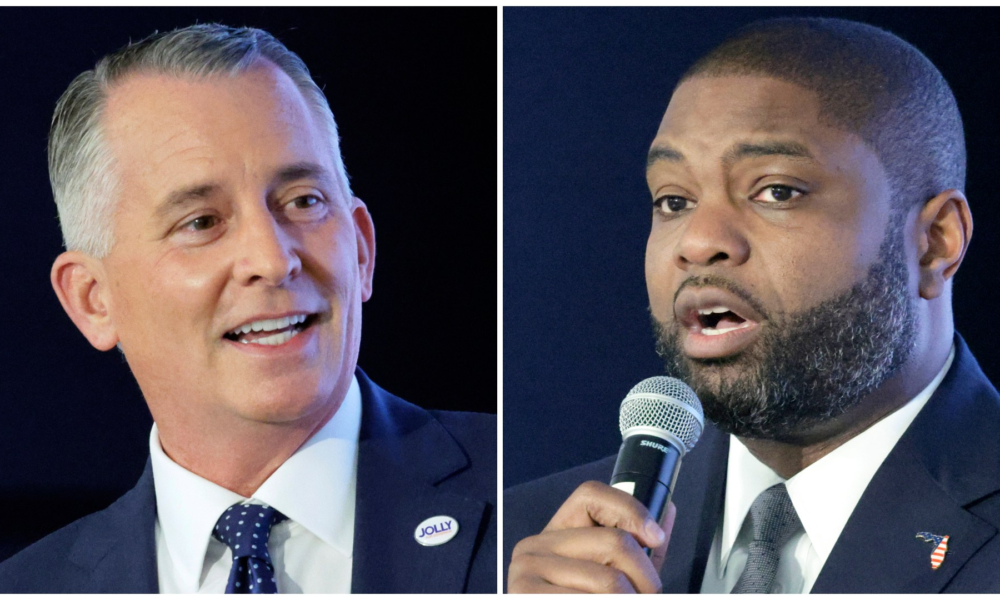
A quartet of public opinion polls in recent days show Republican Byron Donalds with a continuing, albeit narrow, lead over Democrat David Jolly in the race for Florida governor.
In the U.S. Senate race, Republican Ashley Moody enjoys a larger advantage in her contest with Democrat Angie Nixon.
The four polls, all taken within the last two weeks and released in the past week, have different sponsors and methodologies. Taken together they’re positive for Republican candidates but not overwhelmingly so.
Donalds and Moody are both ahead, but neither has hit 50% in averages of the surveys.
The four-poll average in the governor’s race is 48.0%-43.3%, a Republican advantage of 4.7 percentage points in the Donalds-Jolly race.
The Senate race average is 49.5% for Moody and 42.8% for Nixon, an advantage of 6.7 points for the Republican.
“The trendline tends to suggest that this is going to be a tighter election than it has been in the last couple of cycles,” said Kevin Wagner, a political scientist at Florida Atlantic University.
That’s a change. “I think there was a perception that Democrats were just not going to be competitive in Florida going forward, and the numbers suggest that while they’re not the favorites to win, that we have real contests for November.”
G. Elliott Morris, a data analyst and pollster who writes the “Strength In Numbers” Substack, said in a Thursday livestream that “Florida is surprisingly close in the polling,” adding that he wasn’t sure if he believes the governor’s race is as close as some polls indicate.
The major independent ratings — Cook Political Report, Inside Elections, and Sabato’s Crystal Ball at the University of Virginia Center for Politics — have the Florida governor’s race as leaning Republican.
They see the Senate race more likely to go Republican, rating it either solid or safe.
Both Jolly and Nixon are behind, but the numbers represent a notable turnaround for the state’s Democrats.
For a generation, Florida was the premier swing state in the country, one that could go either way in major statewide elections. Ultra-close contests weren’t unusual.
Florida changed dramatically the years after the COVID pandemic.
Early in the pandemic, Gov. Ron DeSantis went along with many of the coronavirus restrictions recommended by public health experts. He changed course, lifting the rules before many other states and aggressively marketed what he called “the free state of Florida.” The people who then flowed to Florida were much more Republican than the transplants who migrated to Florida in the later part of the last century.
When President Donald Trump won the state in 2020, as he was losing his bid for reelection, that year’s 3-point victory was hailed as a “Florida landslide,” which is how people in the political world described anything greater than 1 point in a statewide election.
By 2024, it was so solidly Republican that in 2024, neither Trump nor the Democratic nominee, then-Vice President Kamala Harris, devoted time or significant money to competing in the state.
There are currently 1.55 million more registered Republicans than Democrats in Florida. In November 2020, there were 134,000 more Democrats than Republicans registered to vote in Florida.
Wagner described the numbers as a “huge registration advantage that the Republicans have.”
“This state has become more Republican over the years, so a Democratic candidate to win has to be a candidate who can attract voters across the partisan universe,” he said. That means picking up a lot of no party affiliation/independent voters and some more moderate Republican voters.
Midterm elections are often bad for the president’s party, and Trump’s popularity has decreased as voters express dissatisfaction with higher prices for a range of goods, owing in part to Trump-imposed tariffs on imports and higher oil prices because of the war with Iran.
In the Mason-Dixon poll, 30% of likely voters cited inflation and the cost of living as having the greatest influence on their voting decisions, far ahead of any other issue.
Among registered voters, which includes people who aren’t likely to vote, Targoz Research survey found 80% said changes in gas prices have affected their regular household spending habits. Its survey also found 44% of registered voters said their financial situation is about the same as it was a year ago, 39% said it is worse and 16% said it is better.
The polling suggests Florida’s top Republican candidates aren’t doing nearly as well this year as in 2022, the midterms during Joe Biden’s presidency.
In 2022, DeSantis won reelection with 59.4% of the vote to 40% for his Democratic challenger, Charlie Crist. DeSantis won by 19.4 percentage points.
In the last midterm election, then-U.S. Sen. Marco Rubio won with 57.7% of the vote to 41.3% for his Democratic challenger, then-U.S. Rep. Val Demings. Rubio defeated Demings by 16.4 percentage points.
Trump’s approval is higher among voters in his adopted home state of Florida than it is nationally.
Two of the recent Florida polls asked voters if they approve or disapprove of Trump’s job performance.
YouGov reported 46% approved and 54% disapproved.
In the Mason-Dixon poll, 48% approved and 48% disapproved. Mason-Dixon reported 88% of Democrats disapprove of Trump’s performance and 83% of Republicans approve. Among independents, 36% approve and 55% disapprove of the president’s job performance.
By contrast, the nationwide average Friday at FiftyPlusOne showed Trump’s national approval at 35% and disapproval at 62%.
Among Florida Hispanic likely voters surveyed for Telemundo by Mason-Dixon, 45% approved and 49% disapproved of Trump’s performance.
Republican Donalds is a member of Congress and former state representative. He once was a Democrat.
Democrat Jolly is a former member of Congress. He was a Republican while in office, broke with the party over Trump and became a no-party affiliation/independent and ultimately a Democrat.
DeSantis can’t run again because of term limits.
Governor polls of likely voters:
Targoz Market Research for the right-leaning James Madison Institute, released Friday: Donalds, 52%; Jolly 42%; another candidate, 3%; undecided, 3%.
St. Pete Polls for Florida Politics, released Wednesday: Donalds 45%; Jolly 45%; someone else, 3.9%; undecided, 6.9%.
Mason-Dixon for NBC6/Telemundo, released Tuesday: Donalds, 48%; Jolly, 41%; someone else, 1%; undecided, 10%.
Mason-Dixon for Telemundo poll of Hispanic voters, released Tuesday: Donalds, 48%; Jolly, 43%; someone else 1%; undecided 8%.
YouGov, released Tuesday: Donalds, 47%; Jolly 45%, someone else 1%; undecided 7%.
The St. Pete Polls survey reported that about eight in 10 Democrats and Republicans supported their party’s nominees. Among independents, Jolly led Donalds 49% to 33%.
Mason-Dixon reported almost nine in 10 Democrats and Republicans supported their party’s nominee. Among independents, it reported Jolly led Donalds 47% to 28%.
Campaigns tend to trumpet the polls that contain good news for their candidate, ignore the others, and provide a dose of spin.
A Tuesday release from Donalds about the Mason-Dixon poll included a statement from his chief strategist, Ryan Smith: “This poll reflects what we are seeing on the ground. Between Byron’s non-stop schedule of campaign events, a field army that’s knocked more than 1.5 million doors, and a laser-focus on making Florida more affordable, Byron is well-positioned to win on November 3rd and keep Florida red.”
A Thursday release from Jolly about the St. Pete Polls survey included a statement from senior adviser Mark Riddle. “While it has now become the norm for polling to show this race in a dead heat, David’s strategy remains the same it has all cycle — go everywhere, meet Floridians where they are, and share the change agenda that got us here: housing, healthcare, education, and stopping data centers.
“The more Floridians learn about David, (running mate) Gwen (Graham), and their platform, the more our coalition and our support will grow.”
Republican Moody was appointed to the U.S. Senate by DeSantis when Rubio resigned to become Trump’s secretary of state. She is a former state attorney general.
Democrat Nixon is a state representative.
Polls of likely voters in the Senate race:
Targoz/James Madison: Moody, 52%; Nixon, 42%; another candidate, 2%; undecided 4%.
St. Pete Polls/Florida Politics: Moody, 47%, Nixon, 45%; someone else, 2.3%; undecided 6.0%.
Mason-Dixon/NBC6/Telemundo: Moody, 50%; Nixon, 40%; someone else, 2%; undecided, 8%.
Mason-Dixon/Telemundo poll of Hispanic voters: Moody, 47%; Nixon 40%; someone else, 4%; undecided, 9%.
YouGov: Moody, 49%; Nixon, 44%; someone else, 1%; undecided, 5%.
As in the governor’s race, support for the party nominees in the Mason-Dixon poll was about 90% among Democrats and Republicans. Independents favored Nixon 41% to 35%.
St. Pete Polls reported more than 80% for each of the party’s respective Senate nominees; among independents it said Nixon led Moody, 49% to 36%.
Wagner, who has conducted many public opinion polls in the past, said people shouldn’t pay too much attention to a single poll’s number. Every pollster has different sampling techniques and uses different ways to assess who are likely voters who actually will show up.
Morris said several factors could influence what various polls are showing: Pollsters might not be capturing how enthusiastic Democrats are to vote. It’s also been challenging in recent election cycles to assess the views of Trump supporters because they are less likely to answer surveys.
“The error could go either way. You should be prepared for the polls to either underestimate Democrats or underestimate Republicans,” he said. “We really don’t know.”
St. Pete Polls for Florida Politics: Surveyed 836 likely Florida voters from Oct. 5-7 through automated phone calls and text. Pollster reports a margin of error of plus or minus 3 percentage points.
Mason-Dixon Polling & Strategy for NBC6 (WTVJ-Ch. 6) and Telemundo Station Group: surveyed 625 registered voters, all of whom said they were likely to vote, from Sept. 28-Oct. 1 by live telephone callers. Pollster reports a margin of error of plus or minus 4 percentage points.
Mason-Dixon for Telemundo Station Group: surveyed 400 registered Hispanic voters, all of whom said they were likely to vote, from Sept. 28-Oct. 1 by live telephone callers. Pollster reports a margin of error of plus or minus 5 percentage points.
YouGov: surveyed 3,813 likely Florida voters from Sept. 28-Oct. 5 via text to complete a web-based survey. Pollster reports a margin of plus or minus 3 percentage points.
Targoz Market Research for James Madison Institute (a libertarian, right-leading think tank based in Tallahassee): surveyed 1,200 registered voters, including 857 likely voters, online from Sept. 28-Oct.4. Pollster reports a margin of error of plus or minus 3 percentage points.
For all polls, the margins of error for smaller groups, such as Republicans and Democrats, would be higher because the sample sizes are smaller.
Political writer Anthony Man can be reached at aman@sunsentinel.com and can be found @browardpolitics on Bluesky, Threads, Facebook and Mastodon.
Copyright 2026 Sun Sentinel. All rights reserved. The use of any content on this website for the purpose of training artificial intelligence systems, algorithms, machine learning models, text and data mining, or similar use is strictly prohibited without explicit written consent.