
Europe Today
Euronews' flagship morning TV show with the news and insights that drive Europe, live from Brussels every morning at 08.00. Also available as a newsletter and podcast.
The Ring
The Ring is Euronews’ weekly political showdown, where Europe’s toughest debates meet their boldest voices. In each episode, two political heavyweights from across the EU face off to propose a diversity of opinions and spark conversations around the most important issues of EU affairs and the wider European political life.
No Comment
No agenda, no argument, no bias, No Comment. Get the story without commentary.
My Wildest Prediction
Dare to imagine the future with business and tech visionaries
The Big Question
Deep dive conversations with business leaders
Euronews Tech Talks
Euronews Tech Talks goes beyond discussions to explore the impact of new technologies on our lives. With explanations, engaging Q&As, and lively conversations, the podcast provides valuable insights into the intersection of technology and society.
The Food Detectives
Europe's best food experts are joining forces to crack down on fraud. Euronews is following them in this special series: The Food Detectives
Water Matters
Europe's water is under increasing pressure. Pollution, droughts, floods are taking their toll on our drinking water, lakes, rivers and coastlines. Join us on a journey around Europe to see why protecting ecosystems matters, how our wastewater can be better managed, and to discover some of the best water solutions. Video reports, an animated explainer series and live debate – find out why Water Matters, from Euronews.
Climate Now
We give you the latest climate facts from the world’s leading source, analyse the trends and explain how our planet is changing. We meet the experts on the front line of climate change who explore new strategies to mitigate and adapt.
Europe Today
Euronews' flagship morning TV show with the news and insights that drive Europe, live from Brussels every morning at 08.00. Also available as a newsletter and podcast.
The Ring
The Ring is Euronews’ weekly political showdown, where Europe’s toughest debates meet their boldest voices. In each episode, two political heavyweights from across the EU face off to propose a diversity of opinions and spark conversations around the most important issues of EU affairs and the wider European political life.
No Comment
No agenda, no argument, no bias, No Comment. Get the story without commentary.
My Wildest Prediction
Dare to imagine the future with business and tech visionaries
The Big Question
Deep dive conversations with business leaders
Euronews Tech Talks
Euronews Tech Talks goes beyond discussions to explore the impact of new technologies on our lives. With explanations, engaging Q&As, and lively conversations, the podcast provides valuable insights into the intersection of technology and society.
The Food Detectives
Europe's best food experts are joining forces to crack down on fraud. Euronews is following them in this special series: The Food Detectives
Water Matters
Europe's water is under increasing pressure. Pollution, droughts, floods are taking their toll on our drinking water, lakes, rivers and coastlines. Join us on a journey around Europe to see why protecting ecosystems matters, how our wastewater can be better managed, and to discover some of the best water solutions. Video reports, an animated explainer series and live debate – find out why Water Matters, from Euronews.
Climate Now
We give you the latest climate facts from the world’s leading source, analyse the trends and explain how our planet is changing. We meet the experts on the front line of climate change who explore new strategies to mitigate and adapt.
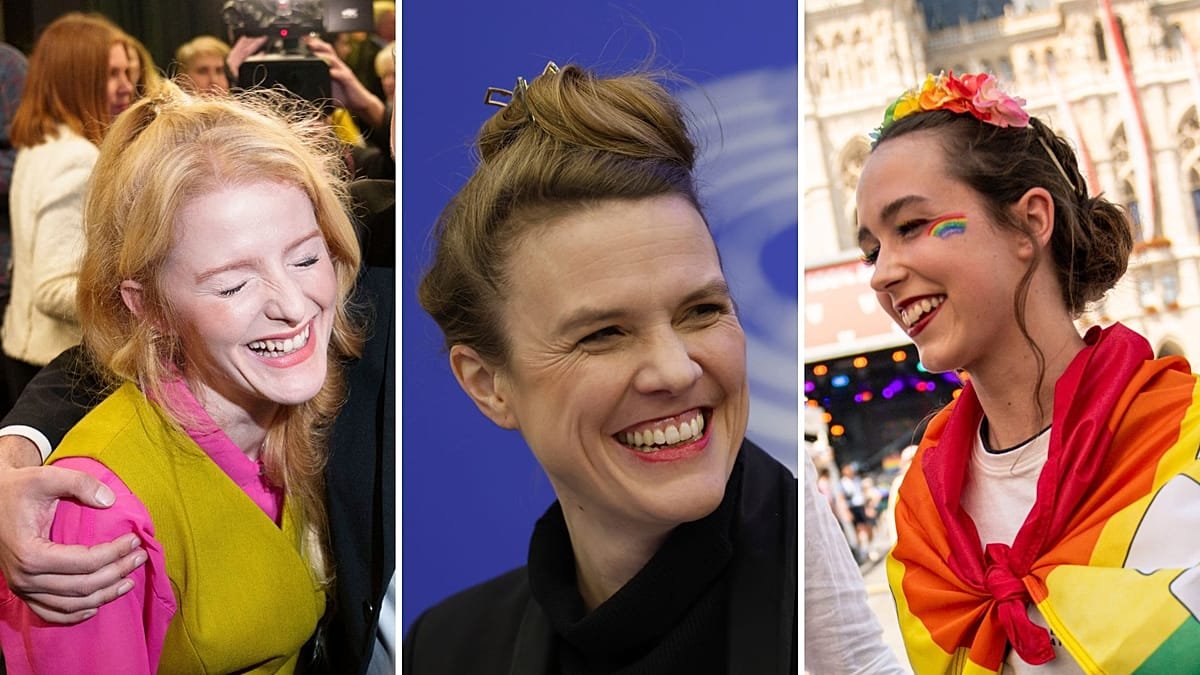
“A Green tidal wave is coming at the next general election,” declared Hannah Spencer, as she became the first ever Green Party MP to be elected in the north of England last week. She and a growing cohort of women are at its crest.
Spencer is not the typical face of green politics. A plumber who left school at 16 and was still completing her plastering training during the campaign, she represents the kind of voter the Green Party – with its middle-class, southern UK heartland – has long struggled to reach.
Promising in her speech to “make lives better for people like us – to bring down the cost of living, introduce rent controls, and get the litter and fly tipping off our streets,” now she seeks to represent them.
That kind of commitment comes at a personal cost. Even before Spencer had taken her seat, her professional and working-class credentials were being questioned, while false rumours of a multimillionaire husband circulated.
“The right don’t like the idea of a young, working-class woman in politics,” she told the New Statesman during the campaign. “They want to keep Westminster for a small club of posh boys that all went to the same schools or studied at Oxbridge.”
A 2019 analysis found that just 7 per cent of all UK MPs came from a ‘working class’ background.
Spencer isn’t the only one facing such backlash.
“Sexist abuse, personal attacks and a loss of privacy are unfortunately part of the reality,” says Lena Schilling, 25, who gave up her life as a Fridays for Future climate activist to become an Austrian Green MEP in 2024.
What may be unique is how the intersection of gender and climate intensifies the attacks.
US research published in the journal Climatic Change found a consistent correlation between sexism, climate denial and opposition to climate policy. The authors argue that this comes down to “system justification” – where individuals fight to protect the existing socio-economic order.
Much of this harassment takes place online, where keyboard warriors can hide behind anonymity and algorithms spur on divisive content.
A survey of politically active people in Germany found that women are targeted more often and more sexually, with about two-thirds experiencing sexist or misogynistic attacks, according to a study by HateAid and the Technical University of Munich.
And it’s not always easy to shake off: 22 per cent of women affected by digital violence said they have at some point considered withdrawing from politics altogether.
“The hostility young women face online still discourages many from speaking out or entering politics in the first place,” Schilling says. “That is something we have to change.”
For Europe’s green parties, this starts from within. The European Green Party is one of just two Europarties with formal gender quotas in place – and while dismissed by some as positive discrimination, a 2024 King’s College London study found quotas remain the only reliably effective method of ensuring women’s representation in party leadership.
“Parity is in our Green DNA,” Terry Reintke, Co-President of the Greens/EFA group and MEP for Germany since 2014, tells Euronews Green.
The Greens/EFA is the only group in the European Parliament with full gender parity, and women hold 68 per cent of European Green Party leadership roles, the highest of any Europarty, according to the KCL study.
Growing up in the Ruhr region – Germany’s former industrial heartland – Reintke has spent her career arguing that green politics and social justice are inseparable.
“When you prioritise inclusion, social justice, and long-term thinking, you naturally open doors to more diverse leadership,” she says. “And that makes a real difference – not just in who sits at the table, but in how decisions are made and whose voices are heard.”
In Germany, the Greens have enshrined co-leadership – one man, one woman – as a founding principle. Eleven EU member states now have legally binding gender quotas for elections. But progress is uneven, and the gap between political will and global reality remains stark.
At the COP30 climate summit last year, women made up just 40 per cent of national delegation members – a rise of only 9 percentage points over 17 years – and fewer than a third of delegations were led by a woman, according to the Women’s Environment & Development Organization (WEDO).
The stakes are not abstract. Researchers consistently find that climate change falls hardest on those with the least power to avoid it. Women and children are 14 times more likely to die than men when extreme weather hits, and an estimated four out of five people displaced by climate change impacts are women and girls.
But when women are empowered, the outcomes improve for everyone: a study across 91 countries found that female representation in national parliaments correlated with more stringent climate policies and lower carbon emissions.
Schilling has seen this first-hand. “A moment that shaped my motivation was when Austrian Green environment minister Leonore Gewessler fought to save the Nature Restoration Law,” she says. “It showed very clearly that one woman in the right place can make decisions that change the future for all of us.”
Spencer’s ambition extends beyond her own seat. “I’m not here to be a career politician,” she said at her first press conference after the result. “I’m here to hold the door open for others who do jobs like mine,” said the 34-year-old.
It’s a sentiment Schilling recognises. “Politics does not only happen in parliaments,” she says. “It happens on the streets, in civil society organisations, in local communities and in movements.
“If you care about the world around you, you are already part of politics. And when more women step forward into leadership, we do not just change politics – we change the future.”
 Browse today's tags