
Home > UPSC Polity Notes > Women in Politics
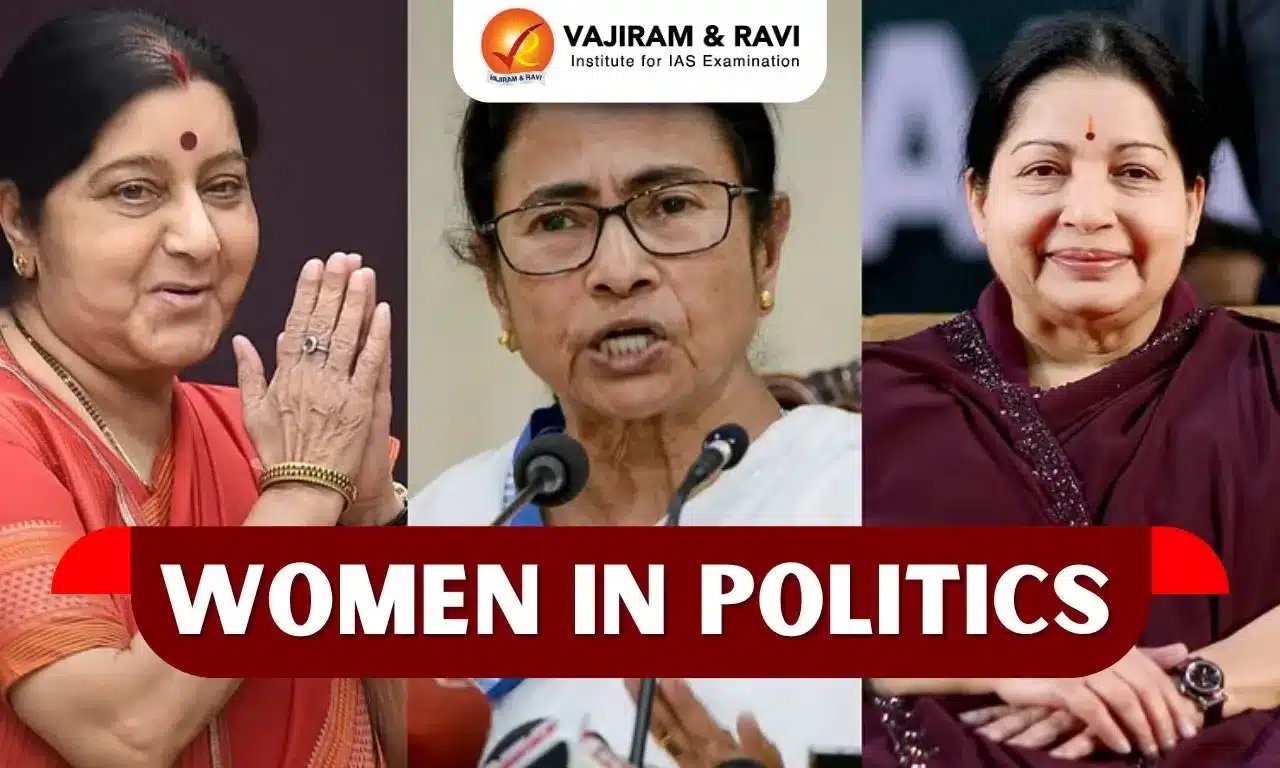
Women’s participation in politics is a cornerstone for democratic representation and gender equality. Check about Women in Politics, Challenges, Measures.
By Vajiram Editor – Jul 5, 2026, 00:04 IST
Women’s participation in politics is a cornerstone for democratic representation and gender equality. Despite global progress, women remain underrepresented in political institutions, and barriers like social norms, systemic challenges, and limited access to resources impede their participation.
However, strides have been made in recent years with international movements, legal reforms, and increasing recognition of women leaders in the political sphere. In the Indian context, the 18th Lok Sabha has 74 women Members of Parliament (MPs). This represents 13.6% of the total 543 seats in the Lok Sabha.
Women’s political participation refers to their involvement in electoral processes, policy-making, and leadership positions. It encompasses voting, standing for elections, holding public office, and being involved in decision-making at all levels of governance. Political empowerment of women is key to achieving gender equality, as it gives women the platform to address issues like education, healthcare, and gender-based violence.
India, the world’s largest democracy, has seen gradual but slow progress in increasing women’s representation in politics. During British rule, limited women had voting rights in India. However, with the passage of the Indian Constitution, all Indian women gained the right to vote and participate, and since then, their participation has evolved, albeit with significant barriers.
Modern constitutional democracy is founded on the principle of proportionate political representation for all populations. The Beijing Declaration (1995) stressed that women’s empowerment and full involvement, based on equality in all areas of culture, including involvement in decision-making processes and authority, are essential to achieving inclusion, growth, and harmony.
Don't miss Vajiram & Ravi updates:
Add Vajiram & Ravi as a preferred source on Google
Several measures have been taken to promote women’s participation in politics, including constitutional provisions for equality, the right to contest elections, seat reservation, capacity-building initiatives, and international commitments aimed at enhancing women’s political representation.
Women in politics face significant challenges such as proxy representation, financial constraints, patriarchal norms, and exclusion from key political roles. Additionally, they encounter violence, intimidation, and cyber-harassment, hindering their active participation in public life.
The way forward for women in politics involves legally mandating political parties to allocate one-third of tickets to women, empowering women’s organisations, providing political training, removing barriers, and ensuring safe, inclusive environments.
Question 1: Discuss the desirability of greater representation of women in the higher judiciary to ensure diversity, equity and inclusiveness. (UPSC Mains 2021)
Question 2: “The reservation of seats for women in the institutions of local self-government has had a limited impact on the patriarchal character of the Indian Political Process.” Comment. (UPSC Mains 2019)
 Last updated on August, 2026
→ UPSC Mains 2026 commenced on 21st August 2026 and will continue through 30th August 2026, as per the official examination schedule.
→ UPSC Mains Question Paper 2026 is out now for Essay & GS Paper 1, 2, 3 & 4.
→ UPSC Mains GS Paper 1 2026 is out now.
→ UPSC Mains GS Paper 2 2026 is out now.
→ UPSC Mains GS Paper 3 2026 is out now.
→ UPSC Mains GS Paper 4 2026 is out now.
→ UPSC Mains Indian Language Paper & English Compulsory Paper are out now.
→ Check out the latest UPSC Syllabus 2026 here.
→ UPSC Mains Admit Card 2026 is now out.
→ Enroll in Vajiram & Ravi’s UPSC Mains Test Series 2027 for structured answer writing practice, expert evaluation, and exam-oriented feedback.
→ Join Vajiram & Ravi’s UPSC Mentorship Program 2027 for personalized guidance, strategy planning, and one-to-one support from experienced mentors.
→ Go through the UPSC Mains Previous Year Papers to enhance your preparation.
→ Download UPSC Mains Essay Paper 2025, UPSC Mains GS Paper-I 2025, UPSC Mains GS Paper-II 2025, UPSC Mains GS Paper-III 2025, UPSC Mains GS Paper-IV 2025, UPSC Mains English (Compulsory) Paper 2025, UPSC Mains Hindi (Qualifying) Paper 2025 here.
→ UPSC has released UPSC Toppers List 2025 with the Civil Services final result on its official website.
→ UPSC Calendar 2027 has been released.
→ Also check Best UPSC Coaching in India
Q1. How many women are there in politics?+
Ans. In the 18th Lok Sabha (2024-2029), there are 74 women MPs out of 543 seats, with the maximum number of women MPs from West Bengal.
Q2. What is women empowerment in politics?+
Ans. Women’s political empowerment involves increasing their participation and representation in decision-making processes, ensuring equal opportunities to contest elections, and promoting women’s leadership roles in political parties and governance structures.
Q3. What is the status of women in politics?+
Ans. Women’s representation in Indian politics remains low. They constitute about 14% of Lok Sabha members and 9% in state assemblies. However, 33% seats are reserved for women in local government bodies.
Q4. What is the role of women in politics?+
Ans. Women in politics serve as legislators, policymakers, and advocates for gender equality. They bring diverse perspectives to governance, champion women’s issues, and work towards inclusive development across various sectors.
Q5. Who are the female politicians of India?+
Ans. Prominent female politicians in India include Sonia Gandhi, Mamata Banerjee, Mayawati, Nirmala Sitharaman, Smriti Irani, Priyanka Gandhi Vadra, and Kanimozhi
Tags: quest women in politics
Central Bank Digital Currency
Women Reservation Bill
Right to Privacy
Recent Posts
UPSC Exam 2026
UPSC Courses
UPSC Notes
About Vajiram & Ravi
About UPSC Exam
UPSC Courses
Install App
Connect on Social Media
Want to Enroll for UPSC CSE Courses ?
Get all your questions answered with our expert counselling!

Other Articles
The Los Angeles Left Is Fighting About Housing – Bloomberg.com